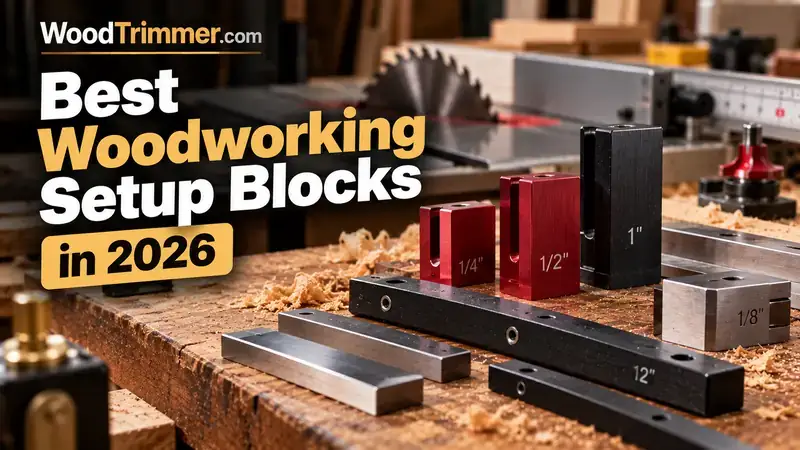
Best Woodworking Setup Blocks in 2026
Setup blocks turn a measurement into a physical reference. Instead of repeatedly trying to read a ruler beside a saw blade or router bit, you place a known dimension where you need it and adjust the machine until the reference fits.
Quick Picks
| Pick | Best for | Why it stands out |
|---|---|---|
| Kreg PRS3400 | Best Overall | Three-gauge design for height, depth and fence-offset setup. |
| iGaging 36-SB-15 | Best Precision Block Set | 15-piece set with stated 0.001-inch block-thickness accuracy. |
| Comfylichi 14-Piece | Best Budget Multi-Function | Affordable set covering height, depth, angle and fence alignment. |
What Are Woodworking Setup Blocks?
Setup blocks are precision reference pieces used to establish a known distance without repeatedly reading a scale. Woodpeckers describes them as useful for setting cutter heights and fence positions on table saws, router tables, drill presses and other machines.
The important idea is physical comparison. If you need a 3/8-inch router-bit height, a 3/8-inch reference can be placed directly against the relevant surfaces. You adjust until the fit is right rather than trying to judge a tiny ruler gap.
The 3 Best Woodworking Setup Blocks
1. Kreg PRS3400 Precision Router Table Set Up Bars
Best for: router tables, table saws and common fractional setups
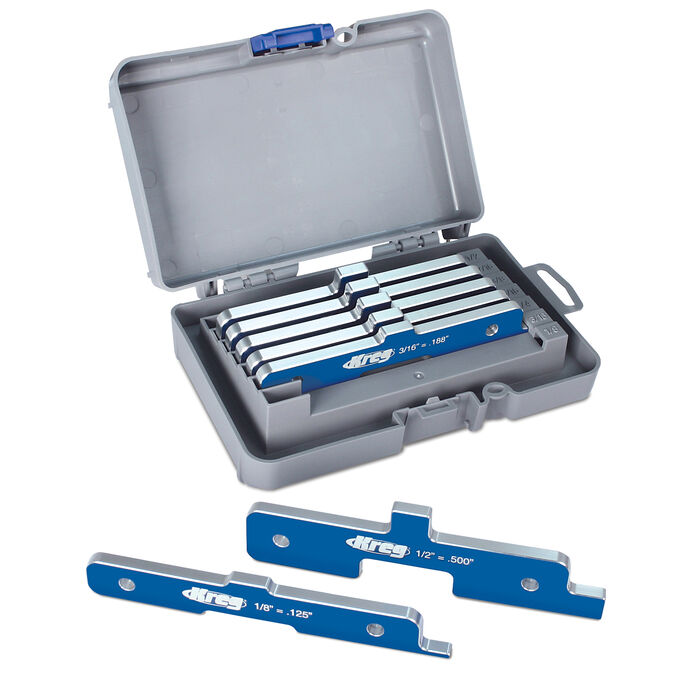
The best starting point if most of your precision setup happens around a router table or table saw and the common fractional sizes cover your work.
Check Price on AmazonKey specifications
- 7 anodized-aluminum setup bars
- 1/8, 3/16, 1/4, 5/16, 3/8, 7/16 and 1/2 inch sizes
- Three-gauge design on each bar
- Concave bottom step for blade/bit height
- Top step for checking completed-cut depth
- End step for fence-offset setup
- Protective case
- Extremely practical three-way design
- Soft aluminum reduces risk of damaging a cutter during setup
- Compact case keeps the common sizes organized
- Excellent fit for router-table workflows
- Imperial sizes only
- Limited to the included fractional dimensions
- Not a substitute for a general-purpose precision block set
2. iGaging 36-SB-15 Right On Precision Setup Block Set
Best for: broader machine setup and precision reference work

The better choice when you want a dedicated precision block set that can cover more dimensions and serve more machine-setup situations.
Check Price on AmazonKey specifications
- 15-piece inch setup-block set
- Solid aluminum construction with blue anodized finish
- Block thickness accuracy stated at 0.001 in / 0.025 mm
- 3-inch-long, 1/2-inch-thick blocks
- Includes a 1 x 2 x 3-inch reference bar
- Engraved size markings
- Protective case
- Broader selection than a basic seven-piece setup-bar set
- Useful physical references for blades, bits and fences
- Manufacturer provides a stated thickness-accuracy specification
- Protective case makes the set practical for a working shop
- More pieces than a beginner may need
- Aluminum blocks require care around sharp cutters
- The stated tolerance is a manufacturer specification, not a claim that every setup will automatically be that accurate
3. Comfylichi 14-Piece Setup Blocks for Woodworking
Best for: affordable height, depth, angle and fence setup

A sensible entry point if you want to experiment with setup blocks without immediately buying a premium precision set.
Check Price on AmazonKey specifications
- 14-piece aluminum setup-block/bar set
- Designed for height, depth, angle and fence alignment
- Includes multiple physical reference shapes
- Stated ±0.005-inch tolerance in the current listing
- Protective storage case
- Current Amazon listing identifies the set as the 14-piece configuration
- Broad functionality for a relatively simple set
- Useful for several common router and saw setup tasks
- Lower-cost way to test whether setup blocks fit your workflow
- Physical references are faster than repeatedly reading a ruler for common dimensions
- Stated tolerance is much looser than the iGaging specification
- Less established precision-tool track record than Kreg or iGaging
- Verify critical dimensions against a known reference before relying on them for fine joinery
Why Setup Blocks Can Be Better Than a Ruler
A ruler tells you what a dimension should be. A setup block gives you something physical to compare against. That distinction becomes useful when the reference point is awkward, such as a router bit height or a saw blade protrusion.
Woodpeckers specifically describes setup blocks as a way to avoid the tedious process of measuring cutter height with rulers and combination squares, while its 3D blocks add several physical reference surfaces to each dimension.
Setup Blocks vs. Calipers vs. Digital Gauges
| Tool | Best strength | Typical woodworking use |
|---|---|---|
| Setup blocks | Fast physical reference | Blade/bit height, fence offset, common depths |
| Digital calipers | Flexible measurement | Thickness, diameter, small dimensions |
| Digital angle gauge | Angle verification | Blade bevels, fences and machine angles |
| Rule / square | General measurement and layout | Initial dimensioning and physical checks |
That is why setup blocks complement the tools from WoodTrimmer Articles 1 and 4 rather than replacing them.
What Makes a Setup Block a Precision Tool?
Known dimension
The stated dimension must be meaningful enough for the intended job. A block labeled 1/2 inch is useful only if its actual reference surfaces are consistent with that dimension.
Stable reference surfaces
Flat, predictable surfaces make physical comparison easier. Surface damage, burrs or contamination can change the result.
Repeatable handling
A good block is easy to place the same way every time. Shape matters because a tool that is awkward to position can introduce operator variation.
Useful dimension selection
A huge set is not automatically better. The best set is the one containing the dimensions you repeatedly use. Kreg’s seven sizes are concentrated around common router and saw dimensions, while iGaging’s 15-piece set offers broader coverage.
How to Use Setup Blocks Correctly
1. Clean both reference surfaces
Remove dust and chips from the machine and the block. A tiny contaminant can become a surprisingly large error when the target is a tight fit.
2. Choose the actual target dimension
Do not choose a nearby size simply because it is convenient. If the desired setup is not one of the included dimensions, stack compatible blocks or use another measuring method.
3. Keep the reference orientation consistent
Use the same surface or step intended for the measurement. Multi-function blocks can have several reference features, but they are not interchangeable.
4. Adjust the machine until the reference is right
Make small adjustments rather than forcing the block into place. You want a controlled fit, not a wedged block.
5. Lock and recheck
Machine locking mechanisms can move a fence or cutter slightly. Always perform a final check after tightening.
Can Setup Blocks Really Improve Repeatability?
Yes—when the same reference is used consistently. Kreg’s design, for example, gives each bar three useful gauge relationships: the bottom step helps set cutter height, the top step checks cut depth, and the end step helps establish fence offset.
That does not mean the machine becomes “calibrated” by owning the block. The repeatability comes from using the same reference and the same setup procedure each time.
How Accurate Should Woodworking Setup Blocks Be?
This is where WoodTrimmer’s precision on paper ≠ precision in the workshop principle matters.
iGaging currently states 0.001-inch / 0.025 mm block-thickness accuracy for its 36-SB-15 set. The Comfylichi Amazon listing currently states a ±0.005-inch tolerance. Those are very different specifications, but neither number alone tells you the final accuracy of a saw cut or router joint.
The machine’s alignment, cutter condition, workpiece reference, locking movement and operator technique all remain part of the result.
Common Setup-Block Mistakes
- Using a dirty block or machine surface.
- Forcing a block into a tight gap instead of making a controlled adjustment.
- Assuming a manufacturer’s tolerance guarantees the accuracy of the entire machine setup.
- Using a block dimension that does not match the actual target.
- Forgetting that stacked blocks can introduce another interface between references.
- Failing to recheck after tightening a fence or cutter-height mechanism.
- Buying a large set full of dimensions you rarely use.
Who Should Buy Setup Blocks?
Buy them if: you repeatedly set router-bit heights, table-saw blade heights, fence offsets, dado depths or other common machine dimensions and want a faster, more repeatable setup.
You may not need them yet if: you mostly perform rough woodworking, rarely change machine settings, or already have a setup system that gives you reliable repeatability.
Frequently Asked Questions
Are setup blocks worth it for woodworking?
For woodworkers who repeatedly configure saws and routers, they can save time and reduce repeated visual measuring. Their biggest benefit is repeatability rather than replacing every other measuring tool.
What is the best woodworking setup block set?
The Kreg PRS3400 is the best overall starting point in this guide because its three-gauge design covers several common machine-setup tasks. iGaging is the stronger choice for broader precision-block coverage.
Can setup blocks replace calipers?
No. Calipers are much more flexible for measuring unknown dimensions. Setup blocks are better when you already know the target dimension and want to reproduce it quickly.
Can setup blocks be used on a table saw?
Yes. They can be used for blade height, fence offsets and related machine setup, provided the block design is suitable for the specific task.
Can setup blocks be used on a router table?
Yes. This is one of their strongest applications. Kreg specifically designs its PRS3400 bars for router-table bit height and fence-offset setup.
Are aluminum setup blocks accurate enough?
They can be, depending on their actual manufacture and intended tolerance. The material itself does not prove accuracy; the relevant question is the specification and the condition of the reference surfaces.
Final Verdict
The Kreg PRS3400 is the best overall choice for most woodworkers because it concentrates on the dimensions and setup relationships commonly needed around routers and saws. Its three-gauge design makes it more useful than a simple collection of flat blocks.
The iGaging 36-SB-15 is the better choice when precision reference blocks are becoming a central part of your machine-setup workflow. The Comfylichi 14-piece set is the sensible budget experiment for woodworkers who want to discover whether setup blocks actually improve their workflow before spending more.
The real advantage is simple: measure once, establish a physical reference, and repeat the setup. That is exactly the kind of small workflow improvement WoodTrimmer is designed to identify.
Related WoodTrimmer Guides
- Different Types of Measuring Tools
- 8 Best Woodworking Layout Tools of 2026
- Woodworking Square Tools
- Woodworking Scribe Tools
- List of Tools for Woodworking
Publishing Checklist
- Confirm Amazon availability before publishing.
- Keep the affiliate disclosure visible near the beginning.
- Check that all three Amazon links retain
tag=shahedru-20. - Confirm all three product images load correctly after pasting into WordPress.
- Use the supplied 800×450 WebP as the featured image.
- Add the article to the appropriate WoodTrimmer machine-setup/measurement category.
- After publication, add the final live URL to future internal-link planning.
Editorial note: This guide intentionally avoids invented prices, ratings and hands-on testing claims. Product listings and specifications can change.