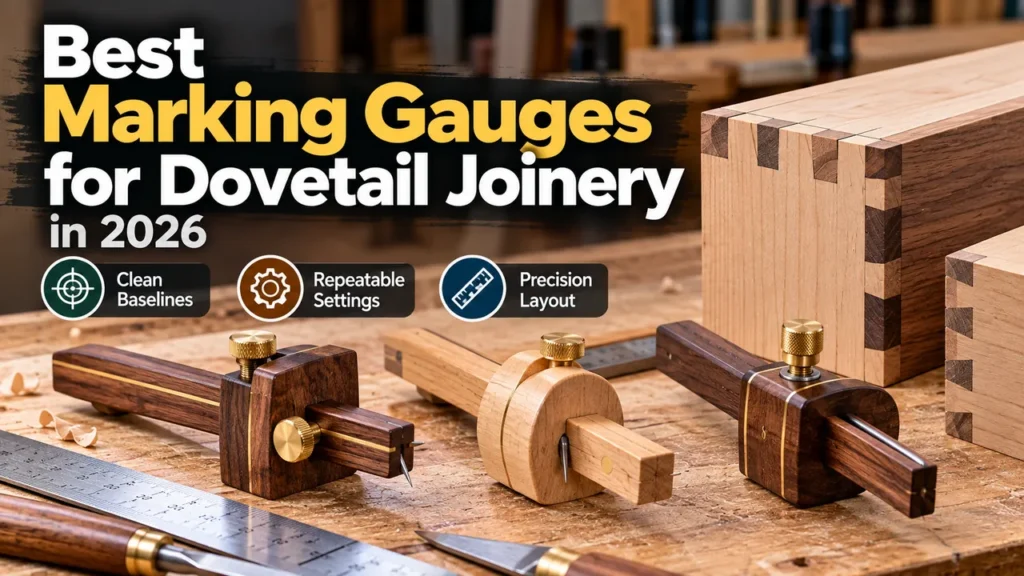
Best Marking Gauges for Dovetail Joinery in 2026
A good dovetail joint starts before the saw touches the wood. The baseline has to be positioned consistently, and that is where a marking gauge earns its place on the bench.
For dovetail work, the important question is not simply whether a marking gauge is “precise.” What matters is whether the fence stays registered against the reference edge, the cutter makes a clean line, and the setting can be repeated without drifting.
Quick Picks
| Gauge | Best for | Why it matters for dovetails |
|---|---|---|
| Taytools 467603 | Best Overall | Simple wheel design, brass head and 8-inch beam |
| iGaging 34-710 | Fine Adjustment | Micro-adjustment for incremental baseline changes |
| iGaging 34-711 | Multiple Joinery Types | Micro-adjustment plus twin mortise cutters |
| Clarke Brothers Wheel Gauge 8 | Budget Precision | Wheel cutter, roll-stop fence and replacement cutters |
Why a Marking Gauge Matters for Dovetails
A dovetail baseline is a reference line. Once it is established, the saw and chisel have a physical boundary to work toward. A gauge lets you transfer the same distance from a reference edge around multiple faces of the board.
That repeatability matters because measuring each face separately introduces more opportunities for small discrepancies. The practical advantage of the gauge is therefore not a marketing claim about microscopic accuracy; it is the ability to set a reference once and reproduce it.
Wheel vs. Pin for Dovetail Layout
For a general-purpose dovetail gauge, we prefer the wheel style. A wheel cutter severs fibers rather than dragging a point through them. That is especially useful when the line crosses the grain.
A traditional pin gauge still has a place in woodworking, particularly for along-the-grain layout. But if you want one gauge primarily for dovetail baselines and general fine joinery, a wheel cutter is the more versatile starting point.
What We Look For
- Fence stability: The head must remain firmly registered against the reference edge.
- Cutter quality: A dull or poorly shaped cutter produces a weak reference line.
- Adjustment control: The setting should lock securely and be repeatable.
- Reference surface: A stable face helps the gauge track consistently.
- Useful beam length: Enough reach for your work without making the tool awkward.
- Maintenance: Replacement or sharpenable cutters are valuable over time.
Our Picks
1. Taytools 467603 Brass-Head Wheel Marking Gauge

8-inch beam; 7/16-inch cutter; 1-9/16-inch head diameter; solid brass head
A straightforward wheel gauge with a substantial brass head. The mass and simple mechanism make it a strong choice when the priority is setting one repeatable dovetail baseline and keeping the gauge easy to understand.
Who should buy it: Woodworkers who want a repeatable gauge setting for joinery layout and who will actually use the tool often enough to benefit from a dedicated marking gauge.
Who should skip it: If you rarely make joinery or only need occasional rough layout, a dedicated precision gauge may add little value.
Check Price on AmazonModel/listing research: manufacturer information cross-checked against the current Amazon ASIN used above.
2. iGaging Micro-Adjust Wheel Marking Gauge 34-710
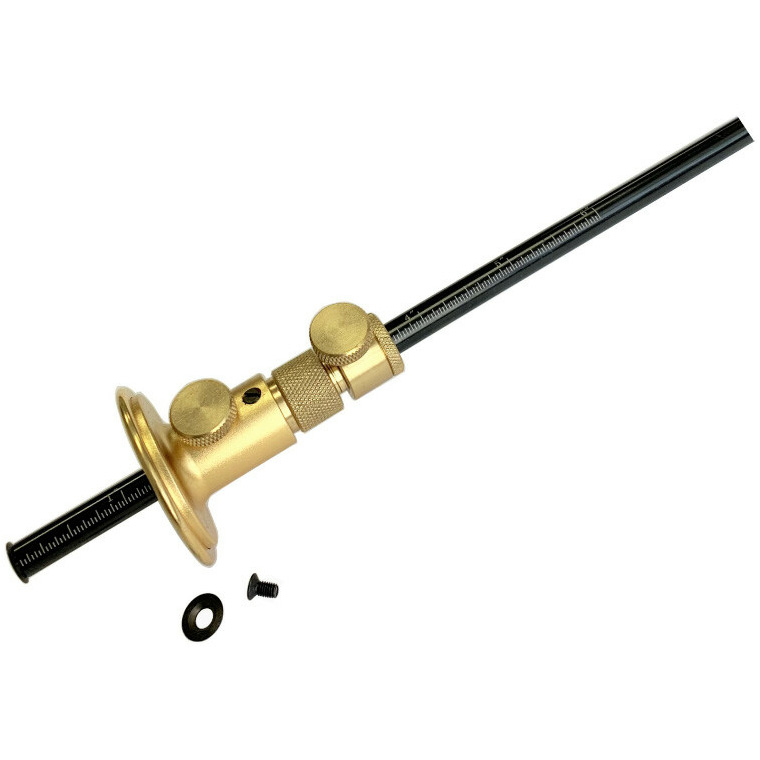
34-710; 1/32-inch and 1 mm graduations; micro-adjust mechanism; brass body; 6-inch shaft
The micro-adjust mechanism is useful when you need to sneak up on a baseline rather than repeatedly loosening and sliding a conventional head. That can be valuable when fitting hand-cut dovetails.
Who should buy it: Woodworkers who want a repeatable gauge setting for joinery layout and who will actually use the tool often enough to benefit from a dedicated marking gauge.
Who should skip it: If you rarely make joinery or only need occasional rough layout, a dedicated precision gauge may add little value.
Check Price on AmazonModel/listing research: manufacturer information cross-checked against the current Amazon ASIN used above.
3. iGaging Mortise Gauge + Wheel Marking Gauge 34-711
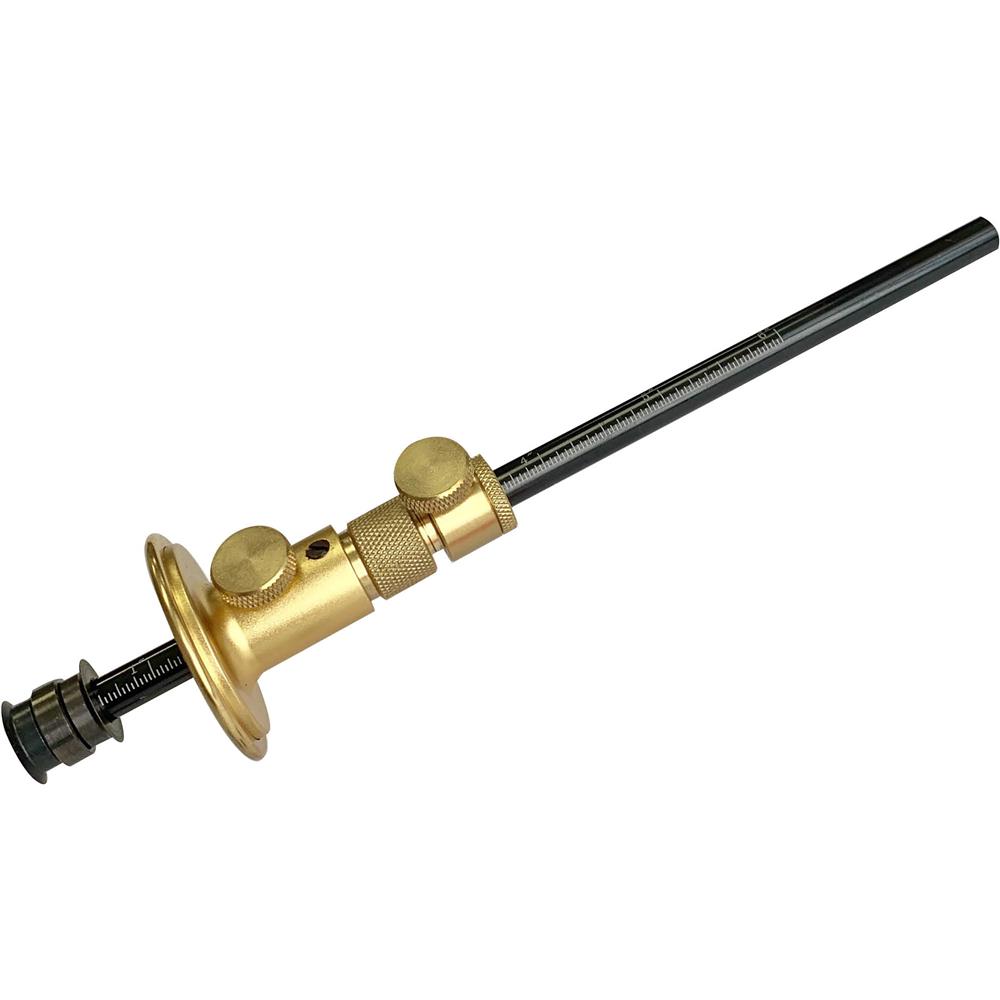
34-711; micro-adjustable; twin mortise cutters; 1/32-inch and 1 mm scale; wheel marking capability
This is more tool than a dovetail-only buyer needs, but it becomes attractive if the same shop also cuts mortise-and-tenon joints. It can serve the dovetail baseline role while adding a twin-cutter function for other joinery.
Who should buy it: Woodworkers who want a repeatable gauge setting for joinery layout and who will actually use the tool often enough to benefit from a dedicated marking gauge.
Who should skip it: If you rarely make joinery or only need occasional rough layout, a dedicated precision gauge may add little value.
Check Price on AmazonModel/listing research: manufacturer information cross-checked against the current Amazon ASIN used above.
4. Clarke Brothers Wheel Marking Gauge 8

8-inch bar; inch/mm graduations; roll-stop fence; hardened wheel; two replacement cutters
A lower-cost way into wheel-gauge layout. The important features for this article are the wheel cutter, fence stability, readable scale and replacement cutters—not decorative construction.
Who should buy it: Woodworkers who want a repeatable gauge setting for joinery layout and who will actually use the tool often enough to benefit from a dedicated marking gauge.
Who should skip it: If you rarely make joinery or only need occasional rough layout, a dedicated precision gauge may add little value.
Check Price on AmazonModel/listing research: manufacturer information cross-checked against the current Amazon ASIN used above.
How to Set a Marking Gauge for a Dovetail Baseline
The most reliable method is to set the gauge from the actual workpiece rather than blindly entering a number from a ruler.
- Prepare a clean reference face and edge.
- Place the gauge’s reference face firmly against the reference edge.
- Set the cutter to the desired baseline position.
- Lock the gauge securely.
- Make a light test mark on scrap or an inconspicuous area.
- Run the gauge around the workpiece using the same reference face and edge.
If the dovetail baseline is intended to match the board thickness, transferring that dimension directly from the workpiece can eliminate an unnecessary measurement step.
Do You Need a Micro-Adjust Gauge?
Not necessarily. A micro-adjust mechanism becomes more valuable when you regularly make fine adjustments to a setting while fitting joints.
For a beginner cutting occasional dovetails, a well-made conventional wheel gauge can be enough. For a woodworker who frequently tunes joint fit, the ability to move the cutter in small controlled increments can save time and make repeated setup easier.
Common Mistakes
1. Measuring from different reference edges
Mark your face side and face edge and use them consistently. The gauge can only repeat what you give it as a reference.
2. Pressing too hard
A deep groove is not automatically a better reference. A controlled scoring pass is generally preferable to forcing the cutter into the wood.
3. Ignoring cutter sharpness
If the line becomes ragged or difficult to follow, inspect the cutter before blaming the gauge mechanism.
4. Assuming graduations are calibration
A scale helps establish an approximate setting. For critical joinery, the workpiece itself can be the better reference.
5. Buying a mortise gauge when you only need a single baseline
Twin-cutter functionality is useful for mortise and tenon work, but it adds complexity that is unnecessary for a dovetail-only workflow.
Who Should Buy a Precision Marking Gauge?
Buy one if:
- You cut dovetails or other hand-cut joinery regularly.
- You want repeatable baseline positions across multiple parts.
- You frequently work to tight joinery tolerances.
- You want a dedicated tool rather than repeatedly measuring with a rule and pencil.
Skip the upgrade if:
- You rarely make joinery.
- Your current gauge holds its setting and produces a clean line.
- You mainly do rough construction where small layout differences are not important.
Frequently Asked Questions
What is the best marking gauge for dovetail joinery?
For most woodworkers, a well-made wheel marking gauge is the best starting point. The Taytools 467603 is a straightforward option, while the iGaging 34-710 is more attractive if fine adjustment is important.
Should I use a wheel or pin marking gauge for dovetails?
A wheel is the more versatile choice for dovetail baselines because it cuts rather than drags through the fibers. A pin gauge can still work well for along-the-grain layout.
How deep should a dovetail marking-gauge line be?
It should be clearly visible and provide a useful physical reference without requiring excessive pressure. The objective is a clean, controlled score rather than the deepest possible groove.
Is a micro-adjust marking gauge worth the extra money?
It can be worthwhile for woodworkers who frequently fine-tune joinery settings. If you mostly set the gauge once and leave it there, a simpler gauge may provide better value.
Can a marking gauge replace a dovetail marker?
No. They perform different jobs. The marking gauge establishes a line parallel to a reference edge, while a dovetail marker establishes the angled geometry of the tails or pins.
Final Verdict
The best marking gauge for dovetail joinery is the one that makes the baseline repeatable, visible and easy to reproduce. You do not need the most elaborate mechanism to achieve that.
Taytools 467603 is the sensible all-round choice for a straightforward wheel gauge.
iGaging 34-710 is the better fit when fine adjustment is a priority.
iGaging 34-711 makes more sense for a shop that cuts both dovetails and mortise-and-tenon joints.
Clarke Brothers Wheel Marking Gauge 8 is the budget-oriented option for woodworkers who want the basic wheel-gauge workflow without moving into premium pricing.
Sources & Research Note
- Taytools product specifications and design information.
- iGAGING Premium Wheel Marking Gauge specifications.
- Clarke Brothers Wheel Marking Gauge specifications.
- Current Amazon ASINs were cross-checked against available Amazon-linked product research.
WoodTrimmer does not claim physical testing of these products. We use manufacturer specifications, current product/listing information and independent woodworking sources to evaluate fit for the stated task.