Every great woodworking project starts with the right tools. Whether you’re building your first shelf or crafting fine furniture, having a reliable set of tools makes all the difference. This guide delivers a comprehensive list of tools for woodworking, organized by function and skill level, so you can build smart, stay safe, and work efficiently. From hand saws to power stations, clamps to safety gear, we cover every essential—and why it matters.
You don’t need everything at once. But knowing what’s available—and what you’ll eventually need—helps you plan, prioritize, and grow your workshop with confidence. The journey of a thousand projects begins with just a few well-chosen tools. Let’s break down exactly what belongs in your shop, starting with the foundation: precision.
Measuring & Layout Tools for Perfect Cuts
Accurate cuts start with accurate marks. These tools ensure every joint fits, every edge aligns, and every dimension is repeatable.
Tape Measure
Use a 16- to 25-foot tape with a secure metal hook—one that doesn’t wiggle. Even 1/8” of play can throw off your project. Stick to one tape per project to avoid calibration drift. Brands like Stanley Power Lock offer durability and reliability.
Pro Tip: Metal hooks stretch slightly over time. Always use consistent pressure when measuring.
Bench Rule
A 12” to 24” steel rule beats a tape for precision. Use it on the bench for marking joints, setting gauges, or checking small parts. Steel resists warping; avoid plastic.
Combination Square
Get a 6” or 12” model with a locking mechanism and all-metal construction. It checks squareness, measures depth, marks parallel lines, and guides layout. Test the lock before buying—cheap models slip.
Try Square
This fixed 90° tool verifies edges and end grain. Its short blade makes it perfect for dovetails and small joinery. Keep it on your bench for quick checks.
Speed Square
A triangular must-have. Slide it onto a board to mark 90° and 45° cuts. Use it as a guide for your circular saw when breaking down plywood. Durable plastic or aluminum versions last for years.
Sliding Bevel
Adjust it to any angle, then lock it down. Perfect for copying roof pitches, splayed legs, or beveled trim. Use it to transfer angles to your saw or router jig.
Marking Knife
Forget pencils for fine work. A sharp marking knife scores wood fibers for clean, precise cuts. It’s the “scalpel” to the pencil’s “crayon.” Use a spear-point style with one flat side so you can align it perfectly with your mark.
Marking Gauge
Scribes a line parallel to an edge. A wheel gauge cuts cleaner than a pin and won’t tear softwood. Keep two—one set to 1/8”, another to 1/4”—so you don’t lose your setting mid-project.
Dividers
Set them to a fixed span and walk them along a board to divide it into equal parts. Essential for spacing dovetails, inlays, or decorative elements evenly.
Hand Saws for Precision Joinery

Hand-powered saws deliver control, quiet operation, and unmatched precision in joinery.
Rip Hand Saw
26” long with 5–6 teeth per inch (TPI). Designed to cut with the grain. Expect a rough cut—plan to clean it with a plane.
Crosscut Hand Saw
Same length, but 8+ TPI. Cuts across the grain cleanly. Use it to trim boards to rough length before refining with machines.
Tenon Saw
A stiff-backed saw with 10 TPI. Ideal for cutting tenons, shoulders, and clean joinery. Get one with at least 3.5” depth of cut.
Dovetail Saw
Smaller, finer (14–18 TPI), and rip-filed. Built for delicate dovetail joints. Lower TPI gives more versatility for both rip and crosscuts.
Japanese Pull Saw (Ryoba)
Cuts on the pull stroke, reducing binding. The Ryoba has two blades: rip on one side, crosscut on the other. Delivers laser-precise, splinter-free cuts.
Coping Saw
A U-frame saw with a thin, removable blade. Perfect for curves, interior cutouts, and scrollwork. Rotate the blade to follow tight turns.
Veneer Saw
Ultra-fine teeth prevent tear-out when slicing thin veneers. Use it with light pressure and a steady hand.
Chisels for Clean, Strong Joints

Chisels shape joints, clean mortises, and refine edges. They’re as essential as hammers.
Bench Chisels
Own a set: ¼”, ½”, ¾”, 1”. Made from high-carbon or chromium-vanadium steel. Beveled on two sides, flat on the back. Use with a mallet for chopping, by hand for paring.
Avoid: Soft handles. Get hardwood with a metal cap to resist splitting.
Paring Chisel
Long, thin blade for fine, controlled cuts. Ideal for trimming tenon cheeks or fitting drawers. Doesn’t handle heavy mallet use.
Mortise Chisel
Thick, heavy-duty blade built to withstand repeated mallet strikes. Use it to chop mortises without bending or chipping.
Corner Chisel
L-shaped cutting edge. Acts like a punch for square notches in cabinetry or hardware mounting.
Planes for Smooth, Flat Surfaces
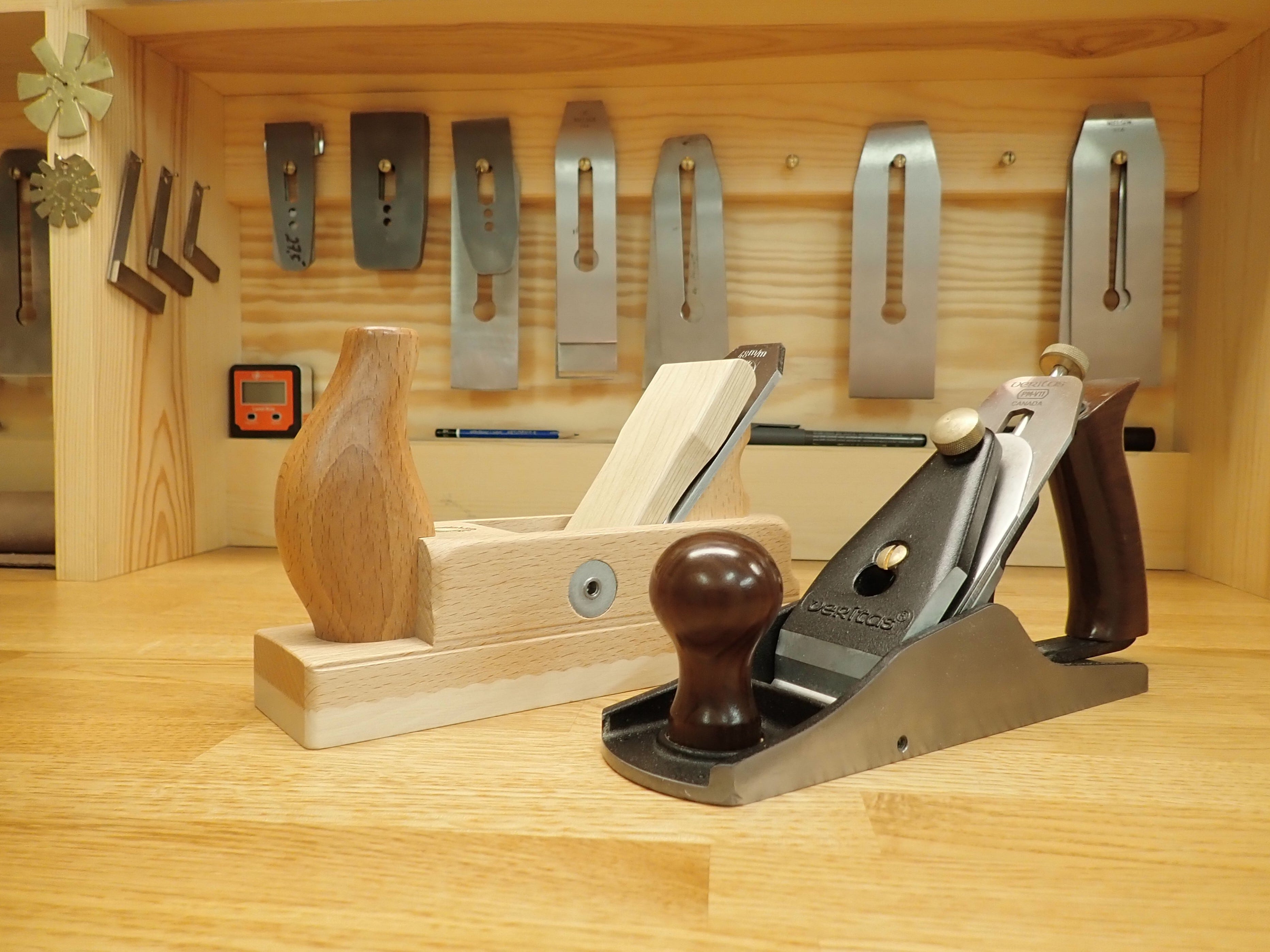
Planes flatten, smooth, and shape wood. They replace sanding and bring out grain beauty.
Jack Plane (#5)
The go-to for general smoothing and flattening. ~14” sole removes material quickly but leaves a decent finish.
Jointer Plane (#7 or #8)
Long sole (22”+) trues long edges for perfect glue-ups. Critical for building panels from narrow boards.
Smoothing Plane (#3 or #4)
Short sole takes ultra-thin shavings. Use it for final surface prep. A well-tuned smoothing plane outperforms sandpaper.
Block Plane
6” long, low-angle. Perfect for end grain, trimming, and chamfering edges. Keep it sharp and handy.
Router Plane
Cuts rabbets, cleans tenon cheeks, and levels biscuit joints. The blade extends vertically, letting you dial in exact depth.
Spoke Shave
Two-handled, curved sole. Shapes chair legs, curved aprons, and any rounded profile.
Card Scraper
A thin steel sheet with a burnished edge. Removes glue, smooths tricky grain (like curly maple), and replaces sanding on difficult woods.
Striking Tools for Controlled Force
Controlled force drives chisels, assembles joints, and shapes wood.
Claw Hammer
20 oz is ideal. Smooth face for finish work; waffle face for framing. Hickory handle absorbs shock better than fiberglass.
Dead-Blow Hammer
Filled with sand or shot to reduce bounce. Use it to seat joints without marring wood.
Mallet
Softer than metal hammers. Use a wood or rubber mallet to protect chisel handles and tools.
- Cabinetmaker’s mallet: Square face, balanced weight
- Carving mallet: Round, heavier head
Nail Set
Drives nail heads below the surface so you can fill and sand. Get a set with multiple diameters.
Hand Drills & Bits for Accurate Holes
Precision drilling without power.
Brace and Bit
A 10” swing brace handles bits from ¼” to 2”. Use it with auger or Jennings pattern bits for clean, controlled holes.
Forstner Bit
Cuts flat-bottomed holes. Perfect for hinge mortises, inlays, or shelf pin holes.
Spade Bit
Fast, aggressive. Use for rough holes in non-visible areas.
Countersink Bit
Creates a conical recess so screw heads sit flush. Combine with a drill bit for one-step operation.
Power Drills for Speed and Efficiency
Portable, fast, and essential for assembly.
Cordless Drill/Driver
Pair it with an impact driver for driving screws. Use the drill for pilot holes, the impact for torque.
Pro Tip: Stick to one battery platform (DeWalt, Milwaukee, etc.) to avoid clutter.
Drill Press
Ensures perfectly vertical, repeatable holes. Use it for doweling, mortising, or drilling through thick stock.
- Benchtop or floor-standing
- Add a laser guide for precision
Clamps That Prevent Glue-Up Failures
Glue-ups fail without clamps. You can never have too many.
F-Clamp (Bar Clamp)
6” and 12” sizes for starters. Strong, reliable, and great for joinery.
Pipe Clamp
Uses standard ½” or ¾” black pipe as the bar. Affordable and extendable. Ideal for large panels.
Quick-Grip Clamp
One-handed operation. Great for holding parts during glue-up or sanding.
Parallel Clamp
Maintains even pressure across wide surfaces. Worth the investment for cabinetmakers.
Strap Clamp
Flexible belt wraps around frames, boxes, or irregular shapes. Use it for picture frames or curved glue-ups.
Hand-Screw Clamp
Wooden body with two screws. Applies high, adjustable pressure. Perfect for tapered legs or uneven stock.
Power Saws: The Core of Your Workshop
The heart of any modern shop.
Table Saw
The heart of most workshops. Use it for ripping, crosscutting, dados, and miters.
Key Features:
– Cast-iron table
– Riving knife (prevents kickback)
– Accurate fence system
– Dust collection port
Jobsite saws (e.g., DeWalt DW745) are portable and affordable. Cabinet saws offer more power and precision.
Track Saw
Glides on a guide rail for perfectly straight cuts. Excellent for sheet goods. Safer than circular saws with better dust control.
Miter Saw
Cuts precise angles. A compound miter saw tilts for bevels. A sliding model cuts wider boards.
- 10” blade: up to 6” crosscut
- 12” blade: more capacity
Band Saw
Cuts curves, resaws thick lumber, and handles irregular shapes.
Key Specs:
– Throat: 12”–18” (width capacity)
– Depth of cut: 6”–12” (with riser block)
– Blade width: 1/8” (tight curves) to 1” (straight resawing)
Jigsaw
For curves, cutouts, and trimming. Choose one with variable speed, orbital action, and a solid base.
Routers & Shapers for Versatile Shaping
One of the most versatile tools in woodworking.
Fixed-Base Router
Set depth once and go. Ideal for edge profiling (roundovers, chamfers) and template work.
Plunge Router
Start cuts in the middle of a board. Perfect for mortises, inlays, and recessed panels.
Router Table
Mount your router under a table for fence-guided cuts. Safer and more precise for raised panels or edge work.
Shaper
Larger, more powerful than a router. Used in production shops for high-volume profiling.
Sanders & Surface Tools for a Flawless Finish
Smooth wood with the right tool.
Random Orbital Sander
Best for beginners. No swirl marks, fast finish. Use with hook-and-loop (Velcro) discs and a shop vac.
Upgrade Tip: Use 3M Extract paper—it lasts longer and removes more dust.
Belt Sander
Aggressive material removal. Use for flattening or shaping. Can gouge if not careful.
Disc Sander
Bench-mounted. Great for shaping edges and curves.
Spindle Sander
Vertical drum sands inside curves. Use with different drum sizes.
Thickness Planer
Flattens and thicknesses boards. Lets you use inexpensive rough lumber. Always joint one face first.
Jointer
Flattens one face and squares one edge. Critical for precise joinery. Use before the planer.
Workshop Essentials: Bench, Horses, and Storage

Your shop needs support systems.
Workbench
The command center. Must have:
– Vise (front or tail)
– Dog holes for bench dogs
– Durable top (hardwood or laminated)
– Storage underneath
Build it or buy it—just make sure it’s solid.
Sawhorses
Support for cutting or assembly. Sturdy models hold 500+ lbs each. Use two with a sheet of plywood for a portable work surface.
Tool Storage
Keep tools accessible:
– Pegboard above the bench
– Rolling toolbox for portability
– Shelves or cabinets for bulk storage
– Mason jars mounted overhead for screws
Safety Gear That Saves Your Health
Protect yourself—woodworking is risky without it.
Safety Glasses
Wear them always. Prescription options like EGGLES fit over glasses.
Hearing Protection
Use earplugs + earmuffs for loud tools (table saw, router). Noise-canceling headphones are not safety-rated.
Respirator
Choose a 3M-style with:
– Pink filters for dust
– Organic vapor cartridges for finishes
Push Sticks
Never feed wood by hand near a spinning blade. Use a Big Horn Push Stick—thin, durable, with a retractable hook.
Dust Collection
Fine dust harms lungs and clogs tools.
– Shop vac with 5+ gallon tank
– Dust separator (keeps fine dust out of filter)
– Air filter to clean shop air after work
Must-Have Accessories for Smarter Woodworking
Small tools, big impact.
Moisture Meter
Prevent warping and joint failure. Use a pinless (scan-type) meter to avoid marks. Wagner IntelliSense™ ignores surface moisture.
Level
- 48” level for large projects
- 8” torpedo level for cabinets
Check both level (horizontal) and plumb (vertical).
Utility Knife
Retractable blade for scribing, trimming, and cleaning joints. Use replaceable blades.
Metal Detector
Scan lumber for hidden nails. Saves your blades and bits.
Feather Board
Holds wood against the fence during sawing. Prevents kickback. Can be homemade.
Biscuit Joiner
Aligns panels and strengthens joints. Uses oval biscuits and a special blade.
Tool Buying Tips: Build Smart, Not Fast
Start small. Prioritize quality. Learn skills.
Start Small
Buy tools as you need them. Begin with:
– Circular saw + guide rail
– Drill/driver
– Clamps
– Square, tape, safety gear
Prioritize Quality
Cheap tools break, slip, and frustrate. Invest in Lie-Nielsen, Veritas, DeWalt, Freud, or Amana.
Buy Used
Find deals on Craigslist, Facebook Marketplace, or Habitat ReStore. Many pro tools last decades.
Build Skills First
Learn with a hand saw and chisel before buying specialty routers.
Recommended Teachers:
– Steve Ramsey – beginner-friendly
– Richard Maguire – hand tool mastery
– Chris Schwarz – philosophy + technique
Recommended Tool Sets for Every Woodworker
Beginner Power Tool Kit (Under $1,500)
- Track saw + guide rail
- Cordless drill + impact driver
- Trim router
- Jigsaw
- Random orbital sander
- Table saw (DeWalt DW745)
- F-clamps and pipe clamps
- Combination square, speed square, tape
- Safety glasses, hearing protection, respirator
Hand Tool Starter Set
- Rip and crosscut handsaws
- Tenon and dovetail saws
- Bench chisels (¼”–1”)
- Jack, jointer, smoothing planes
- Mallet
- Wheel marking gauges (2)
- Marking knife, bevel gauge, dividers
- 10” brace with Jennings bits
Core 7 Power Tools
- Table Saw
- Miter Saw
- Router
- Jointer
- Thickness Planer
- Band Saw
- Random Orbital Sander
Final Note: A well-equipped shop grows over time. Start with precision, add power, and never skip safety. With this complete list of tools for woodworking, you’re ready to build with confidence—whether it’s a birdhouse or a built-in cabinet. Keep learning, keep building, and keep your tools sharp.