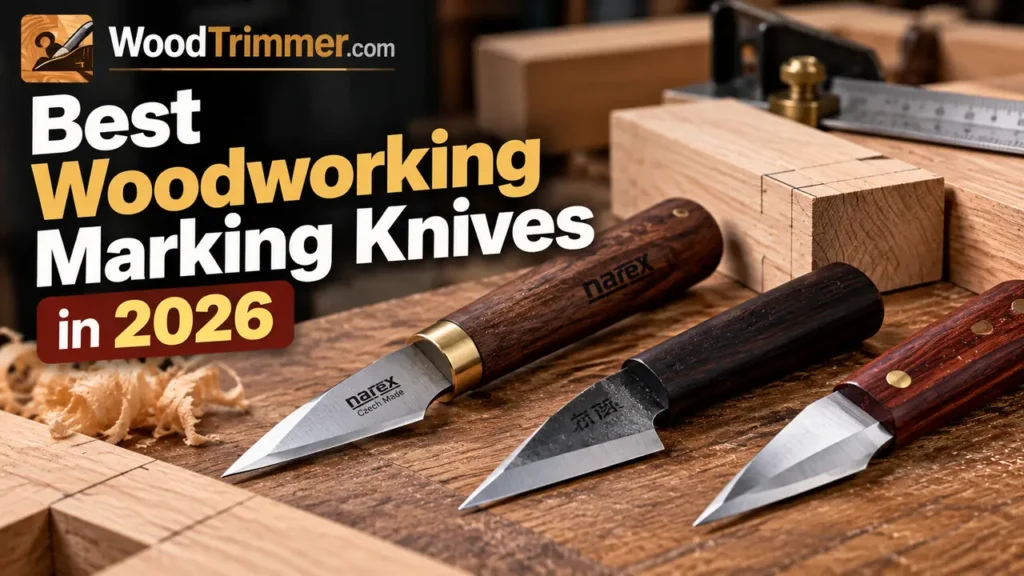
Best Woodworking Marking Knives in 2026
A marking knife turns a layout dimension into a physical reference line. For fine woodworking, that can be a major advantage: the line is narrow, the wood fibers are actually severed, and a saw or chisel can use the groove as a precise starting point.
Quick Picks
| Pick | Best for | Why it stands out |
|---|---|---|
| Narex 822301 | Best Overall | Compact, precise double-bevel marking knife with hardened Mn-V steel. |
| KAKURI 18mm Kiridashi | Best Single-Bevel Choice | Traditional single-bevel geometry for controlled reference-edge registration. |
| RUITOOL Double-Bevel | Best Value / Ambidextrous | Simple dedicated marking knife with double-bevel flexibility and a sheath. |
Why Use a Marking Knife Instead of a Pencil?
A pencil mark is useful because it is fast, visible and easy to erase. But it also has width. When a joint is cut directly against a pencil line, the woodworker still has to decide where within that line the blade belongs.
A marking knife creates a much more definite reference. It cuts the fibers and produces a narrow groove that can help a chisel register against a shoulder or a saw establish its starting position. That is particularly valuable for dovetails, mortise-and-tenon shoulders, rebates, dados and other hand-cut joinery.
The 3 Best Woodworking Marking Knives
1. Narex Marking Knife 822301
Best for: general precision joinery and repeated bench work

The strongest all-around choice when you want a dedicated woodworking marking knife that can handle dovetails, shoulders, transfer work and general precision layout without being overly specialized.
Check Price on AmazonKey specifications
- Model 822301
- Mn-V alloy-steel blade
- Blade hardened to HRc 61
- 1.5-inch blade with 6.75-inch overall length
- Double-bevel marking/striking geometry
- European hornbeam handle with brass ferrule
- Strong balance between precision, control and versatility
- Double-bevel geometry works from either direction
- Compact handle gives good fingertip control
- Established edge-tool manufacturer
- Double bevel is not the ideal geometry for every straightedge-registration task
- The pointed blade demands careful storage and handling
- Requires sharpening maintenance like any fine marking blade
2. KAKURI Kiridashi Knife 18mm
Best for: fine registration against a square or straightedge

A specialist choice for woodworkers who understand single-bevel registration and want a traditional Japanese marking knife for very controlled layout work.
Check Price on AmazonKey specifications
- 18 mm blade width
- Single-bevel Japanese kiridashi geometry
- Japanese high-carbon steel laminated with soft iron
- Hand-forged construction
- Hammered finish
- Right-hand orientation
- Single bevel provides a flat reference side for controlled layout
- Traditional kiridashi form is excellent for fine scribing
- Hand-forged laminated blade is straightforward to sharpen
- Can also handle light shaving and detail work
- Right-hand version is not the universal choice for left-handed users
- Carbon steel needs more rust prevention than stainless steel
- Requires more technique than a general-purpose pencil-style marking tool
3. RUITOOL Double-Bevel Woodworking Marking Knife
Best for: accessible general-purpose marking and scribing

The practical entry choice for a woodworker who wants a dedicated marking knife, especially when left/right-hand flexibility and simple construction matter more than premium blade metallurgy.
Check Price on AmazonKey specifications
- Double-bevel blade
- High-carbon steel blade
- Hardwood handle with riveted construction
- Leather sheath
- Designed for left- and right-handed marking
- Spear-point style marking tip
- Straightforward design makes it easy to understand and use
- Double bevel supports marking in either direction
- Wood handle and sheath give it a traditional workshop feel
- Useful entry point for woodworkers moving beyond pencil layout
- Double bevel gives less flat-side registration than a true single-bevel knife
- Budget construction should not be confused with calibrated precision
- Edge condition and sharpening will have a major effect on line quality
Single-Bevel vs. Double-Bevel Marking Knives
This is one of the most important choices in a marking knife. A single-bevel knife has one relatively flat reference side. When that side is placed against a square or straightedge, the geometry can be very controlled. A double-bevel knife has bevels on both sides, making it more naturally ambidextrous and convenient when marking from either direction.
| Feature | Single bevel | Double bevel |
|---|---|---|
| Reference against a straightedge | Excellent when the flat side is correctly registered | Requires more care because neither side is completely flat |
| Left/right flexibility | Often hand-specific | Usually easier to use from either direction |
| Dovetail transfer work | Excellent for controlled registration | Very versatile, especially when working from both directions |
| Learning curve | Requires learning which face should reference | Generally intuitive for beginners |
| Best reason to choose it | Maximum control over a specific reference face | Versatility and bidirectional use |
How a Marking Knife Improves Repeatability
The biggest benefit is not a theoretical claim about a blade being “more accurate.” It is the workflow. Establish a reference face, position the square or guide, make a light first pass, and then deepen the same groove. The existing groove becomes a physical reference for subsequent passes.
This matters when several components need matching shoulders or when a transferred line must correspond closely with the mating component. In dovetail work, for example, a knife can transfer the tail profile onto the pin board before sawing.
How to Use a Marking Knife for a Cleaner Line
1. Establish the correct reference face
Do not casually change which face of the board you are referencing. Consistency is part of precision.
2. Start with a light pass
Do not try to create the deepest possible groove on the first stroke. A light initial cut gives you a chance to correct the position before committing to a deep line.
3. Let the existing groove guide the next pass
Once the tip has established a clear line, use that groove to deepen the mark rather than repeatedly searching for the original position.
4. Keep the blade sharp
A dull point encourages excessive pressure. That can make the knife wander, crush fibers or make the operator lose control.
5. Mark waste immediately
For joinery, identifying the waste side after establishing the line is a simple habit that prevents an otherwise accurate layout from becoming an incorrect cut.
Marking Knife vs. Marking Gauge
The two tools complement each other rather than compete.
| Task | Marking knife | Marking gauge |
|---|---|---|
| Repeated line parallel to an edge | Possible, but slower | Excellent |
| Dovetail layout | Excellent | Useful for baselines |
| Tenon shoulder | Excellent | Excellent |
| Transferring an irregular shape | Excellent | Limited |
| Setting a repeatable edge offset | Requires a separate guide | Excellent |
If your work is dominated by parallel offsets, keep the marking gauge from Article 2. If your work involves transferring shapes, establishing knife walls or marking across the grain, add a marking knife.
How to Choose the Best Marking Knife
Choose single bevel when registration is the priority
A single-bevel knife can put a flat reference face directly against a square or straightedge. This is one reason traditional Japanese kiridashi-style knives remain attractive for precision layout.
Choose double bevel when versatility matters
A double-bevel knife is convenient when you need to work from both directions or want a more naturally ambidextrous tool. It can be especially practical for a shared workshop.
Look at the tip before the handle
For precision layout, the geometry around the tip matters more than decorative handle materials. A comfortable handle is valuable, but the point is what actually establishes the line.
Consider the workpiece
A narrow blade can reach into tight dovetail spaces. A more substantial blade can feel more controlled for general bench work. Match the knife to the joinery you actually perform.
Common Marking Knife Mistakes
- Using a dull knife and compensating with excessive pressure.
- Using the wrong bevel side against a reference edge.
- Trying to make a deep line in one aggressive stroke.
- Changing the reference face between mating parts.
- Using a marking knife as a general-purpose cutting knife.
- Leaving a sharp knife loose on the bench or in a pocket without protection.
- Assuming an expensive handle automatically means better layout accuracy.
Who Should Buy a Woodworking Marking Knife?
Buy one if: you are learning dovetails, mortise-and-tenon joinery, fine cabinetmaking, furniture making, inlay or other work where a crisp physical reference line improves control.
You may not need one yet if: your work is mainly rough construction, framing, large outdoor projects or other tasks where a pencil line is already more than sufficient.
Frequently Asked Questions
What is the best marking knife for woodworking?
For the broadest range of precision layout in this guide, the Narex 822301 is the strongest overall choice. The KAKURI is better suited to woodworkers who specifically want traditional single-bevel geometry, while the RUITOOL is a practical value option.
Is a single-bevel marking knife more accurate?
It can be easier to place accurately against a straightedge because the flat side provides a clear reference surface. That advantage depends on using the correct face and maintaining good technique.
Are double-bevel marking knives good for dovetails?
Yes. Their versatility can be useful when transferring dovetail geometry from one board to another. A single-bevel knife can offer a more direct flat-side reference in certain layout operations, so the choice depends on technique.
Can I use a marking knife instead of a marking gauge?
Sometimes, but they solve different problems. A gauge excels at repeating a parallel distance from an edge. A knife excels at establishing and transferring precise lines that do not necessarily run parallel to an edge.
Should a marking knife arrive razor sharp?
Some products are supplied ready to use, while others may benefit from honing before serious work. Do not assume factory sharpness; inspect the tip and establish a clean working edge before precision layout.
Do I need an expensive marking knife?
No. Precision comes from the combination of suitable geometry, a sharp edge, stable reference technique and repeatable workflow. A more expensive knife can improve materials, ergonomics or refinement, but it does not remove the need for technique.
Final Verdict
The Narex 822301 is the best overall choice in this trial because it offers a strong combination of compact control, hardened Mn-V steel and double-bevel versatility.
The KAKURI 18mm Kiridashi is the specialist choice for woodworkers who want the distinctive registration behavior of a single-bevel Japanese marking knife. The RUITOOL Double-Bevel is the sensible value choice when you want a dedicated marking knife without moving into premium-tool pricing.
Most importantly, a marking knife should be viewed as part of a precision workflow, not as a magic accuracy tool. Establish a reliable reference, use a light first pass, keep the edge sharp, and let the physical groove guide the next operation.
Related WoodTrimmer Guides
- 8 Best Woodworking Layout Tools of 2026
- Different Types of Measuring Tools
- Woodworking Square Tools
- Woodworking Scribe Tools
- List of Tools for Woodworking
Publishing Checklist
- Confirm Amazon availability before publishing.
- Keep the affiliate disclosure visible near the beginning.
- Check that all three Amazon links retain
tag=shahedru-20. - Confirm all three Amazon product images load correctly after pasting into WordPress.
- Use the supplied 1280×720 WebP as the featured image.
- Add the article to the appropriate WoodTrimmer layout/measurement category.
- After publication, add the final live URL to future internal-link planning.
Editorial note: This guide intentionally avoids invented prices, ratings, hands-on testing claims and unsupported precision numbers. Product listings and specifications can change.