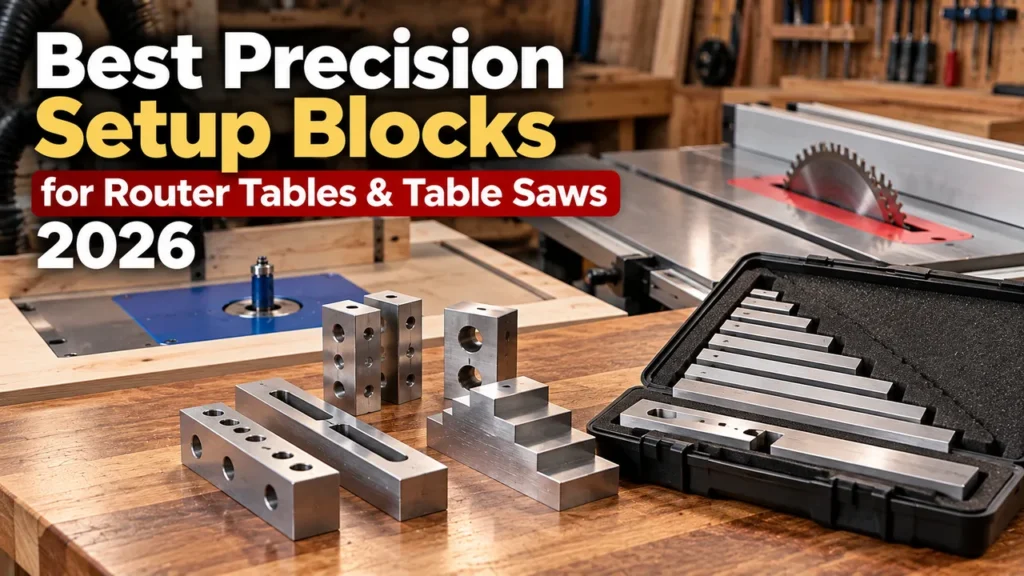

Best Precision Setup Blocks for Router Tables & Table Saws in 2026
Precision setup blocks solve a simple woodworking problem: how do you set a blade, router bit, fence or depth without repeatedly reading a ruler and making tiny adjustments?
Instead of treating the measurement as a number you have to transfer, a setup block gives you a physical reference. Place the correctly sized block where you need the reference, adjust the machine until the parts meet, and the setup becomes easier to repeat.
This guide focuses on setup blocks and stepped setup bars that are particularly useful for router tables, table saws and repeatable machine setup. The important differences are not simply the number of pieces in a kit; they include the available sizes, the geometry of the reference surfaces, the accuracy claimed for the blocks, and how easily the set handles real shop tasks.
Quick Picks
| Setup system | Best for | What makes it different | Shopping |
|---|---|---|---|
| Kreg PRS3400 Precision Router Table Setup Bars | Best stepped setup system | Three-gauge design combines height, cut-depth and fence-offset functions. | Check Amazon |
| iGAGING 36-SB15-B 15-Piece Setup Block Set | Best traditional block set | 15-piece aluminum set with stacked dimensions and a 1 × 2 × 3 reference block. | Search Amazon |
| Infinity Tools 8-Pc. Precision Tool & Project Setup Blocks | Best large-format block design | Long 4-inch blocks plus a 1-2-3 block for larger reference distances. | Search Amazon |
Why Setup Blocks Can Be More Repeatable Than a Ruler
A ruler tells you where a measurement is. A setup block lets you physically transfer that measurement to the machine.
That distinction matters when a cutter is difficult to read from above, when the work area is obstructed, or when you need to repeat the same setting several times. Woodworking sources have long described setup blocks as useful for setting router-bit height, blade height, fence position and other machine relationships.
There is also a practical advantage: the reference does not depend on holding a thin ruler perfectly square while simultaneously adjusting a machine.
Best Precision Setup Blocks and Bars
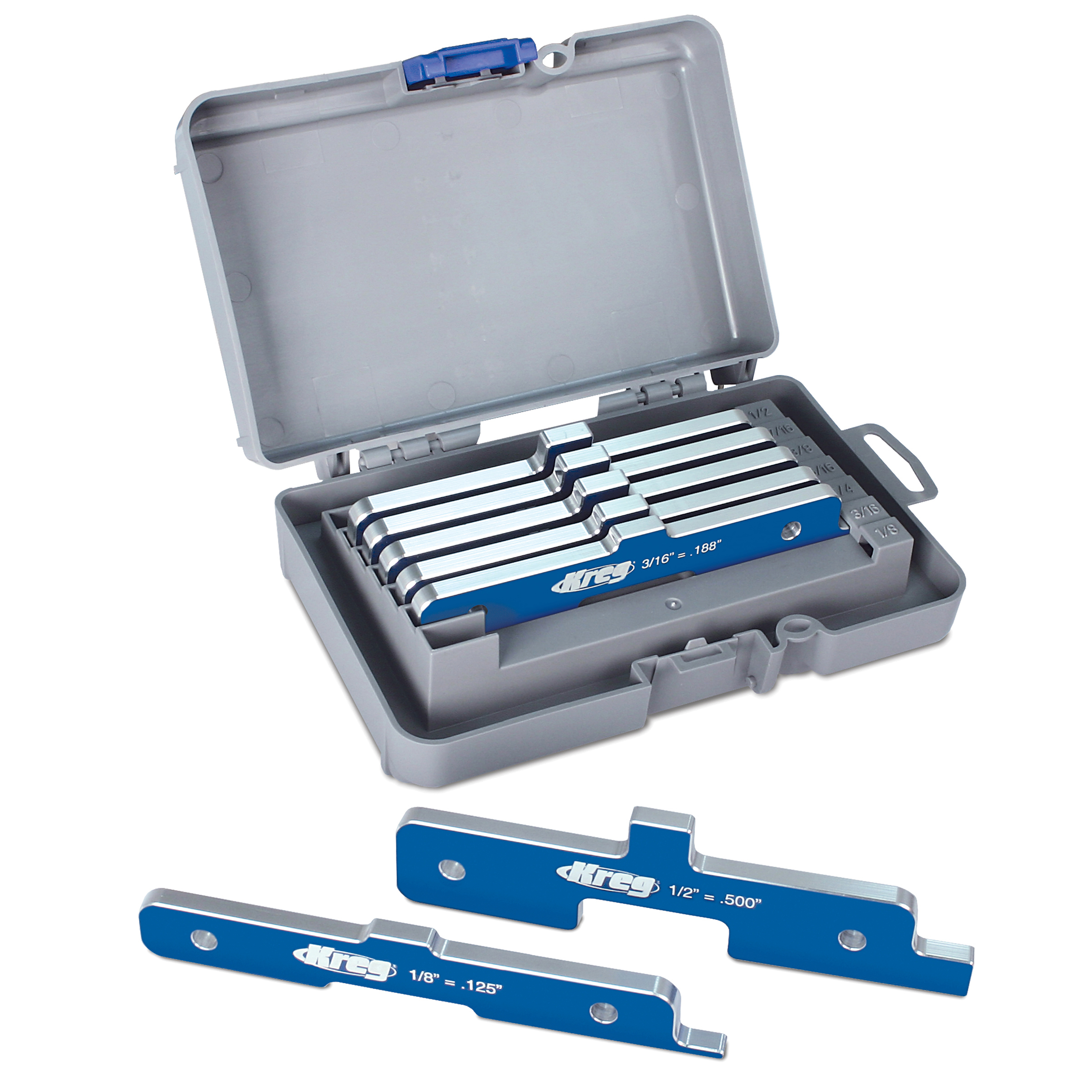
1. Kreg PRS3400 Precision Router Table Setup Bars
The Kreg PRS3400 is different from a conventional stackable block set. Each of its seven anodized-aluminum bars uses a three-gauge design: a concave lower step for setting cutter height, a top step for checking completed cut depth, and an end step for setting the distance between a blade or router bit and a fence.
The set includes seven sizes from 1/8 to 1/2 inch, plus a protective case. Kreg lists compatibility with routers, router tables, table saws and circular saws. The bars are made from soft aluminum so accidental contact during setup is less likely to damage a cutting edge.
Best for: woodworkers who want one compact system specifically designed around common machine-setup tasks rather than a large collection of individual blocks.
Limitation: the fixed sizes are convenient, but they do not provide the same broad stackable measurement range as a larger traditional block set.
Check Kreg PRS3400 on Amazon
2. iGAGING 36-SB15-B Precision Setup Block Set
The iGAGING 15-piece set takes the more traditional gauge-block approach. Woodcraft identifies the model as 36-SB15-B and lists solid aluminum construction, a black anodized finish, laser-engraved imperial markings and a protective foam-lined case.
The set includes blocks from 1/16 through 3/4 inch plus a 1 × 2 × 3-inch reference block. The blocks can be stacked to combine measurements, and Woodcraft lists a block-thickness accuracy of 0.001 inch. It also includes 15/32 and 23/32-inch blocks that can be useful when checking common dado widths.
Best for: woodworkers who want a conventional physical-reference system that can be stacked for different dimensions.
Limitation: a block set requires you to understand which blocks to combine; it does not provide the specialized three-step geometry of the Kreg bars.
Search iGAGING 36-SB15-B on Amazon
3. Infinity Tools 8-Pc. Precision Tool & Project Setup Blocks
Infinity’s set takes a smaller-piece-count approach but gives the individual blocks substantial physical size. The seven setup blocks are each 4 inches long and 3/4 inch wide, with thicknesses of 1/16, 3/32, 1/8, 3/16, 1/4, 1/2 and 3/4 inch. A separate 1-2-3 block extends the system for larger reference dimensions.
The company states that the seven setup-block thicknesses are machined to within 0.002 inch and that the blocks are black-anodized aluminum with laser-etched 1/32-inch scales. The 1-2-3 block provides 1, 2 or 3-inch reference dimensions.
Best for: woodworkers who prefer longer blocks that are easy to hold against fences, tables and machine surfaces.
Limitation: the set has fewer individual thicknesses than a 15-piece system, so stacking is part of the workflow for intermediate dimensions.
Search Infinity Setup Blocks on AmazonSetup Blocks vs. Setup Bars: What’s the Difference?
The terms are sometimes used interchangeably, but the physical designs are different enough to matter.
| Feature | Traditional setup blocks | Stepped setup bars |
|---|---|---|
| Measurement method | Choose one block or stack several | Use the built-in step/reference geometry |
| Machine height | Excellent | Excellent |
| Fence offset | Good when the block geometry suits the measurement | Excellent on designs with an end step |
| Cut-depth checking | Depends on block geometry | Built into some stepped bars |
| Measurement flexibility | High with enough blocks | Centered around the supplied sizes |
| Storage | Often larger sets | Often compact |
How to Use Setup Blocks for Router-Bit Height
- Disconnect the router from power. Never adjust a cutter against a reference block with the machine powered.
- Choose a block matching the required height or use a combination whose dimensions add to the target.
- Place the block on a stable reference surface.
- Raise or lower the router bit until the intended reference point meets the block.
- Lock the router height according to the router manufacturer’s procedure.
- Recheck the setting after locking. Mechanical adjustment can sometimes shift a setup slightly.
With a stepped bar such as the Kreg, the concave lower step is specifically designed to straddle a router bit or saw blade for height adjustment.
How to Use Setup Blocks for a Table Saw
Setup blocks are useful for setting blade height and checking fence offsets, but the exact method depends on the block geometry and the saw.
For example, Kreg’s end step is designed to set the distance from a table-saw blade to the fence, while Infinity describes using its blocks to set blade height and rip-fence position.
Always disconnect power before placing a reference near a blade, and use the table-saw manufacturer’s adjustment and safety procedure.
What Actually Matters When Buying Setup Blocks
1. Dimensional accuracy
The most important specification is the accuracy of the physical reference surface. A beautifully marked block is not useful if its actual thickness is wrong.
2. Available sizes
More pieces are not automatically better. Look at the dimensions you actually use: common dado widths, router-bit heights, blade heights and fence offsets may matter more than the total piece count.
3. Stackability
If the set is designed to stack, the interface between blocks matters. You want stable contact surfaces rather than a stack that can rock while you are adjusting a machine.
4. Reference geometry
Some bars do more than provide thickness. Kreg’s three-gauge design demonstrates why geometry can be more useful than simply increasing the number of pieces.
5. Material
Aluminum is common because it is relatively light and less likely to damage cutting edges than a hard steel reference would be if accidental contact occurs. That does not mean every aluminum set has identical dimensional accuracy.
6. Storage and identification
Clear markings and an organized case reduce setup time. A precision tool that takes several minutes to identify and retrieve is less efficient in everyday machine setup.
Common Mistakes
- Assuming the printed dimension proves the block’s actual thickness.
- Stacking blocks on dirty or damaged reference surfaces.
- Using a flexible or unstable stack while adjusting a fence.
- Forgetting that locking a machine adjustment can shift the setting slightly.
- Using a setup block as a substitute for proper machine alignment.
- Choosing a huge set simply because it contains more pieces.
- Failing to disconnect power before positioning a block near a cutter.
Who Should Buy Precision Setup Blocks?
- Serious hobbyists who frequently change router-bit or table-saw settings.
- Furniture and cabinet woodworkers who need repeatable machine setups.
- Woodworkers making repeated dados, grooves, rabbets or similar cuts.
- Anyone tired of repeatedly transferring measurements with a ruler.
Who Should Not Buy Them?
- Someone who uses a table saw or router only occasionally and rarely needs repeat settings.
- A beginner who has not yet learned the basic principles of safe machine setup.
- Someone who already owns accurate gauges that perform the same tasks and is not experiencing a workflow problem.
- A buyer expecting setup blocks to correct a fundamentally misaligned machine. They are reference tools, not alignment-correction systems.
FAQ
Are setup blocks more accurate than a ruler?
They can make a setup more repeatable because the physical reference is transferred directly rather than being read and then transferred manually. The actual result still depends on the block’s dimensional accuracy, the machine’s adjustment mechanism and how the reference is used.
Can setup blocks be used for both router tables and table saws?
Yes. Many sets are designed for both. Kreg explicitly lists router tables and table saws among the compatible applications for PRS3400.
Do I need a 15-piece setup block set?
No. A smaller stepped-bar system may be better if your most common setups fall within its supplied sizes. A larger block set becomes more useful when you regularly need many different dimensions.
Can I make my own setup blocks?
You can make physical references from other materials, but the key issue is dimensional accuracy and stability. For precision machine setup, commercially machined blocks offer a known reference dimension that is easier to verify and repeat.
Final Verdict
Kreg PRS3400 is the strongest choice if your priority is fast, purpose-built setup for common router-table and table-saw operations. Its three-gauge geometry gives it capabilities that a simple collection of thickness blocks does not.
iGAGING 36-SB15-B is more attractive if you prefer a conventional stackable setup-block system with many individual reference dimensions.
Infinity Tools’ 8-piece set sits between those approaches: fewer pieces, but unusually long blocks plus a 1-2-3 block that can make larger reference measurements easier.
The important lesson is that precision setup is not just about reading a smaller number on a ruler. It is about creating a stable physical reference that you can reproduce every time you return to the machine.
Research & Verification Note
Product specifications were checked against manufacturer or established retailer documentation. This article does not claim hands-on testing by WoodTrimmer. Current prices, ratings and availability can change. Amazon links for products without a sufficiently verified current ASIN intentionally use Amazon search rather than an invented product URL.
Amazon tracking tag: woodtrimmer-20