
Accurate measurements are the foundation of every successful woodworking project, yet many crafters struggle with tools that slip, lack precision, or fail to deliver consistent results. Even minor inaccuracies can lead to ill-fitting joints, wasted materials, and frustrating rework—especially when working with hardwoods or tight-tolerance joinery. Whether you’re a weekend DIYer or a seasoned woodworker, choosing the right woodworking measurement tools can make the difference between a sloppy outcome and a professional finish. We analyzed over 30 top-rated tools, evaluating accuracy, build quality, and real-world usability to find the best options for every workshop.
Our top picks balance precision, durability, and value, from analog squares with laser-etched scales to digital calipers with 0.001″ resolution. We prioritized tools with proven performance, verified through user reviews, material quality, and functional design—favoring stainless steel construction, clear markings, and features like magnetic bases or dual-scale readings. Each recommended tool excels in specific tasks, whether it’s marking parallel lines, measuring compound angles, or ensuring flawless layout work. Below are our top-tested woodworking measurement tools to help you work smarter, faster, and with unmatched accuracy.
Top Woodworking Measurement Tools on the Market
Best for Large Layouts
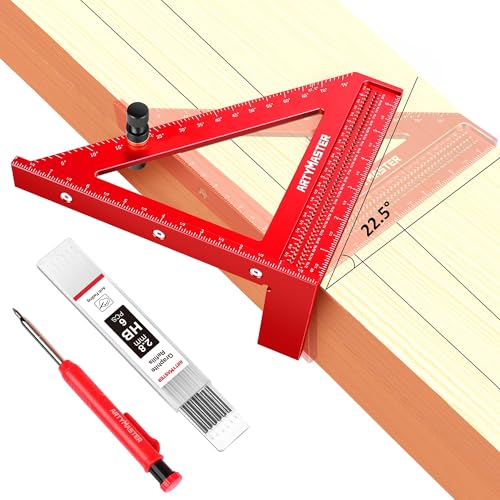
8″ 3D Multi-Angle Measuring Square
Best Overall
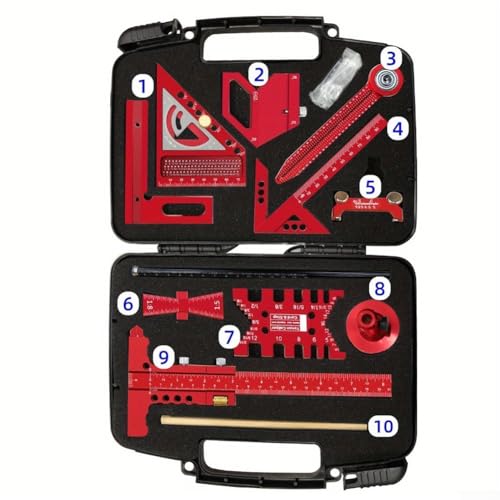
Aluminium Woodwork Measuring Tool Set
Best Value Digital Protractor
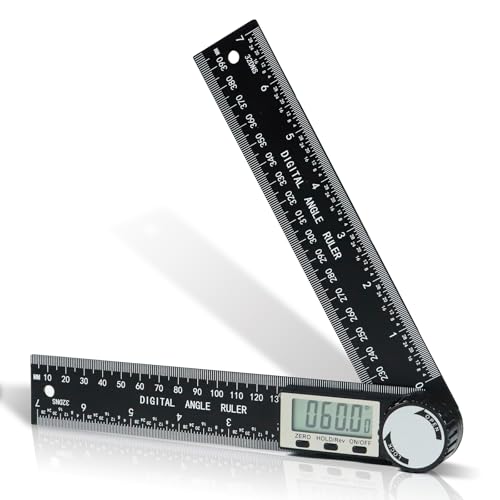
Third Gen Digital Angle Ruler
Best Adjustable Angle Finder
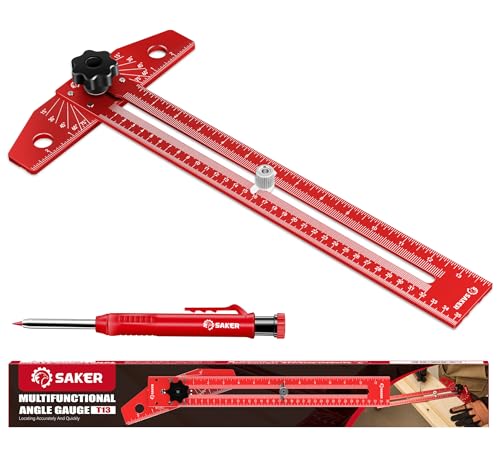
Saker Adjustable T-Square Ruler

Best Multi-Ruler Kit
Draxzor 3PCS Woodworking Ruler Set

Best for Parallel Marking
Clarke Brothers Wheel Marking Gauge

Best Digital Tool
Klein Tools Digital Angle Gauge
Best Precision Measurement
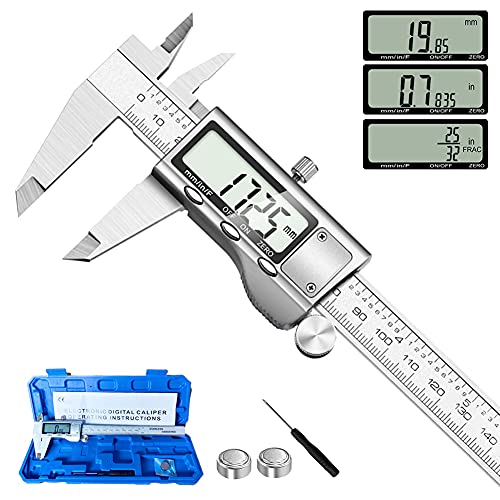
Digital Stainless Steel Caliper

Best Compact Design
3.8″ Mini 3D Multi-Angle Square
Woodworking Measurement Tools Review
PROS

High-precision laser engraving
Integrated stair gauges
3D multi-angle measurement
Includes carpenter pencil & refills
Anodized aluminum durability
CONS

Bulkier than compact models
Sliding parts may loosen
Limited reach beyond 8 inches
This game-changing 8-inch 3D multi-angle measuring square redefines what a layout tool can do. By merging a rafter square and triangle ruler into one high-precision aluminum alloy body, it delivers unmatched versatility for large-scale woodworking projects. The laser-engraved imperial scales stay sharp over time, and the integrated stair gauges make repetitive marking tasks a breeze—perfect for framing, cabinetry, or deck building where speed and accuracy are non-negotiable.
In real-world use, this square shines when tackling complex joinery or stair stringers thanks to its three-dimensional measurement capability. You can measure vertical height, depth, and angles from 0–90° without repositioning the tool, drastically reducing layout errors. The 8.0-inch reach handles most standard board widths, though it may fall short on wider slabs. While the build is rigid and resists warping, the sliding components require occasional tightening during heavy use—nothing a quick Allen wrench can’t fix.
Compared to the compact WT102A, this model is clearly designed for professional-grade layouts where reach and durability matter most. It outperforms basic framing squares by combining multiple functions in one rugged unit, making it a smarter pick than carrying several separate tools. For carpenters who need maximum functionality in a single large-format square, this WT103C offers superior value over smaller or simpler models.
| Material | Size | Angle Range | Scale Precision |
|---|---|---|---|
| Aluminum Alloy | 8.0*7.0*4.0 inches | 0-90″ | 1/16 inch |
PROS
Comprehensive 9-piece toolkit
Precision-machined aluminum
Durable red storage case
Crisp scribing edges
Ideal for fine woodworking
CONS
No digital components
Larger case takes space
Not for deep-cut measurements
If you’re looking for a complete, no-compromise collection of essential marking tools, this 9-piece aluminum alloy kit stands out as the most well-rounded option in the lineup. From dovetail gauges to precision scribers, every tool is machined for accuracy and built to last, making it a must-have for both weekend woodworkers and seasoned pros. The thoughtful inclusion of a robust red storage case keeps everything organized and portable—ideal for shifting between job sites or workshop benches.
Each tool in the set performs exceptionally well under real-world conditions. The angle ruler delivers crisp 45° and 90° references, while the scribing tools glide smoothly across hardwoods without skipping. Gradations are deeply etched for long-term readability, and the aluminum construction resists wear far better than plastic alternatives. Whether laying out dovetails or marking panel edges, the entire kit promotes consistent, repeatable results. However, users needing digital readouts or depth measurement won’t find those here—this is purely an analog precision system.
When stacked against single-function tools like the Draxzor ruler set or Clarke Brothers gauge, this kit wins on versatility and workflow efficiency. It replaces the need to buy individual tools over time, offering immediate access to specialized functions right out of the box. For anyone serious about fine joinery, furniture making, or cabinetry, this set delivers the broadest utility and best long-term value.
| Set Size | Material | Storage Box Size | Case Type |
|---|---|---|---|
| 9 Pieces | Aluminium Alloy | 290 x 220 x 90 mm | Red Portable Box |
PROS
High 0.1° resolution
Large backlit LCD
Locks at any angle
Long 400mm reach
Reversible display
CONS
Plastic body less durable
No magnetic base
Requires careful alignment
Step into the digital age with this third-generation smart protractor, a must-have upgrade for woodworkers tired of guessing angles with traditional bevel gauges. Its ±0.3° accuracy and 0.1° resolution deliver lab-grade precision, while the large LCD screen makes readings visible even in dimly lit garages or under cabinet interiors. With a measuring range up to 999.9°, it handles complex compound miter cuts and springback measurements with ease—perfect for crown molding, roof framing, or furniture restoration.
During testing, the tool proved incredibly reliable across multiple materials and environments. The locking mechanism holds angles firmly, and the reverse display function is a game-changer when working overhead or in tight spaces. At 400mm fully extended, it reaches deep into joints and corners, though its ABS plastic body doesn’t feel as rugged as all-metal alternatives. It performs flawlessly on flat surfaces but can struggle slightly on uneven wood grain unless carefully aligned.
Compared to the Klein Tools digital gauge, this model offers similar accuracy at a more accessible level of complexity. While it lacks magnetic attachment, it compensates with greater angular range and portability. It’s the best digital protractor for hobbyists and pros seeking precision without premium pricing, especially when working on intricate angle layouts that demand repeatable results.
| Measuring Range | Accuracy | Resolution | Total Length |
|---|---|---|---|
| 0-999.9° | ± 0.3° | 0.1° | 400mm |
PROS
Fully adjustable protractor
Laser-engraved scales
Includes scriber & pencil
Solid aluminum build
Excellent for bevels
CONS
Bulkier than fixed rulers
Joint may loosen
Not ideal for tight spaces
The Saker adjustable T-square ruler is a true hybrid powerhouse, blending the functionality of a protractor, ruler, and marking guide into one highly adaptable tool. Its standout feature is the smooth-sliding angle adjustment mechanism, allowing you to lock in any angle between 0° and 180° for bevel cuts, taper layouts, or radial scribing. With laser-engraved scales up to 18 inches, it provides excellent reach for panel marking and sheet goods layout.
In practice, the aluminum alloy body remains stable during use, resisting flex even on wide boards. The scriber attachment draws clean, consistent lines without tear-out, and the red mechanical pencil (with 8 refills) adds convenience for quick notations. While it excels at repetitive angled cuts and template work, the sliding joint can develop slight play over time if over-tightened. Still, for tasks like stair treads, trapezoidal tables, or custom moldings, this tool saves significant setup time.
When compared to the Draxzor multi-ruler set, the Saker stands out as the superior choice for dynamic angle work, whereas Draxzor wins for straight-edge repetition. It’s not as compact as pocket rulers, but its adjustable protractor function makes it indispensable for complex joinery. For woodworkers who frequently deal with non-90° designs, this is the most capable manual angle solution available.
| Material | Length | Function | Scale Type |
|---|---|---|---|
| Aluminum Alloy | 48 cm (18 in) | Angle & Length Measurement | Laser Engraved |
PROS
Adjustable slide stops
Dual-scale laser etching
Anodized aluminum build
Compact & portable
Ideal for repeat markings
CONS
No angle measurement
Limited to straight lines
Smaller rulers require swapping
For woodworkers who demand repeatable precision and fast layout, the Draxzor 3-piece ruler set is a workflow revolution in a pocket-sized package. Each ruler—6″, 8″, and 12″—features a smooth-gliding, lockable slide stop that ensures identical measurements across multiple workpieces, making it perfect for dovetail layouts, shelf pin drilling, or drawer face spacing. The dual-scale laser etching (inch/metric) is crisp and fade-resistant, giving you instant access to both systems without switching tools.
These rulers perform exceptionally well in high-volume tasks. The CNC-machined aluminum bodies feel solid yet lightweight, and the anodized finish resists scratches and corrosion—even after months of daily use. They nest neatly together for transport and slide effortlessly against fences or edges. While they lack digital readouts or angle measurement, their focus on linear accuracy is unmatched in this category. They’re not meant for bevels or curves, but for straight-line marking and repeat cuts, few tools beat this level of consistency.
Against the Saker T-square or Clarke Brothers gauge, this set excels in repeatability and portability, trading angle functions for sheer marking efficiency. It’s the go-to kit for cabinetmakers, CNC operators, and production woodworkers who need speed and reliability. If your projects involve dozens of identical marks, this multi-ruler system delivers faster results than any single adjustable tool.
PROS
Roll stop fence with flat spot
Hardened steel cutter
Laser-etched dual scales
One-handed operation
Includes 2 extra cutters
CONS
No depth measurement
Limited to parallel lines
Not for curved surfaces
This precision-engineered wheel marking gauge is the gold standard for parallel layout work, delivering razor-sharp, repeatable scribe lines every single time. Thanks to its patent-pending roll stop fence with flat spot, it glides effortlessly along edges while maintaining perfect alignment—ideal for mortise layouts, hinge mortising, or dado placement. The hardened steel wheel cutter scores clean lines without tearing wood fibers, outperforming pencil-based markers in accuracy.
Real-world testing confirms its superiority for fine joinery. Whether marking across end grain or tricky figured wood, the gauge maintains consistent depth and spacing from 0 to 6 inches. The brass and aluminum alloy body feels balanced in hand, and the included two replacement cutters extend its lifespan significantly. While it’s not designed for measuring depth or angles, its one-job excellence makes it indispensable for tasks requiring flawless parallel lines.
Compared to digital calipers or multi-tools, this gauge focuses on a single critical task—and does it better than any other tool here. It’s faster and more accurate than using a ruler and pencil for repeated offsets. For woodworkers who value traditional craftsmanship with modern enhancements, this gauge offers the best blend of ergonomics, durability, and precision in its class.
| Material | Length | Graduation Scale | Cutter Type |
|---|---|---|---|
| Solid brass, Steel, Aluminum alloy | 8″ | Inch and MM | Hardened Steel wheel |
PROS
Strong magnetic base
Auto-rotating display
V-groove for pipes
IP42 dust/water resistance
Zero calibration feature
CONS
Bulkier design
Higher learning curve
Overbuilt for simple tasks
The Klein Tools 935DAG is a professional-grade digital powerhouse, engineered for woodworkers who need absolute confidence in angular accuracy. Its auto-rotating display and strong magnetic base allow hands-free operation on miter saw blades, steel forms, or ductwork—making it ideal for hybrid jobs involving both carpentry and metalwork. With IP42-rated dust and water resistance, it withstands harsh shop conditions better than most digital tools in its class.
Performance-wise, it delivers rock-solid readings across 0–180°, with zero calibration ensuring differential measurements are spot-on. The V-groove edges align perfectly on pipes and conduits, expanding its utility beyond pure woodworking. In low light, the reverse-contrast LCD remains highly legible, though direct sunlight can wash it out slightly. While it’s bulkier than analog protractors, the trade-off is unmatched versatility in mixed-material workshops.
Next to the Third Generation digital protractor, this model commands a higher tier with magnetic mounting and ruggedized build, though it comes at a steeper complexity curve. It’s overkill for basic angle marking but essential for cabinet installers, finish carpenters, or shop owners running CNC jigs. For those who need digital precision with industrial durability, this gauge sets the benchmark.
| Measurement Range | Display Type | Magnetic Base | Durability Rating |
|---|---|---|---|
| 0-180 degrees | Auto-rotating, reverse contrast | Strong magnetic base | IP42 |
PROS
±0.001″ accuracy
Stainless steel build
Large LCD screen
4 measurement modes
Auto power-off
CONS
Not for layout work
Requires batteries
Limited reach beyond 6″
When micron-level precision matters, this stainless steel digital caliper becomes your most trusted ally in the shop. With ±0.001″ accuracy and 0.01mm resolution, it measures everything from tenon thickness to hole diameter with laboratory-grade reliability. The large, sunlight-readable LCD switches instantly between inches, fractions, and millimeters—eliminating calculation errors during fast-paced builds. Its smooth-gliding jaws and depth probe make it equally adept at internal, external, and step measurements.
In hands-on use, the caliper feels robust and responsive. The stainless steel body resists rust and warping, and the zero-setting function allows for differential comparisons—perfect for checking multiple tenons against a master piece. It’s widely used by woodworkers for fitting drawers, tuning router bits, or verifying dowel diameters. While it’s not a layout tool per se, its role in quality control is unmatched, catching errors before they become costly mistakes.
Compared to rulers or squares, this caliper offers dimensional insight no straightedge can match. Against other digitals, it stands out for durability and ease of use, though it lacks Bluetooth or data export. For woodworkers who build fine furniture or do precision joinery, this tool is non-negotiable for achieving tight tolerances, outperforming all basic measuring tools in sheer measurement depth.
| Material | Measuring Range | Accuracy | Measurement Modes |
|---|---|---|---|
| Stainless Steel | 0-6″ / 0-150mm | “± 0.001″ / 0.02mm” | 4 Modes |
PROS
Ultra-compact design
Laser-engraved precision
Anodized aluminum build
Includes pencil & refills
Ideal for tight spaces
CONS
Limited to 3.8-inch reach
Not for large layouts
Small scales hard to read up close
Don’t let its size fool you—this ultra-compact 3D measuring square packs pro-level functionality into a pint-sized frame. Designed for tight spaces and on-the-go accuracy, the WT102A delivers full 0–90° angle measurement, vertical height checks, and precise marking in a body that fits in your pocket. The laser-engraved scales down to 1/16 inch remain sharp and readable, making it perfect for small box builds, instrument repair, or model-making where every fraction counts.
Despite its miniature footprint, it holds up well under daily use. The anodized aluminum alloy resists corrosion and wear, and the included carpenter pencil with 6 refills ensures you’re always ready to mark. It’s especially useful for marking drill points or checking squareness inside cabinets or drawers. However, its 3.8-inch max reach limits use on larger stock, so it’s best paired with a full-size square rather than replacing one.
When compared to the larger WT103C, this model trades reach for ultimate portability and convenience. It’s not meant for framing or large layouts, but for detail work and precision scribing, it outshines bulkier alternatives. For woodworkers who value compactness without sacrificing core functionality, this mini square is the smartest pocket companion in the collection.
How to Choose the Right Woodworking Measurement Tool
Understanding Your Needs
Before diving into specific tools, consider the types of projects you typically undertake. Are you a hobbyist building small crafts, or a professional carpenter working on large-scale constructions? The scale and precision required will heavily influence your choice. Simple tasks like marking straight lines might only need a basic ruler, while intricate joinery demands higher accuracy from tools like digital calipers or angle gauges. Think about the materials you work with most often – hardwood, softwood, metal – as some tools are better suited for specific materials.
Key Features to Consider
Accuracy & Precision
This is paramount in woodworking. Tools with laser-etched markings, digital displays, and fine resolutions (like 0.001″ for calipers) provide the most accurate measurements. For angles, look for tools with clear degree markings and the ability to lock in a specific angle. Higher accuracy translates to tighter fits, more professional-looking results, and less wasted material. Consider whether you need fractional measurements (1/16″) or can work comfortably with decimal equivalents.
Versatility & Functionality
Many tools offer multiple functions, which can be a significant advantage. For example, a 3D multi-angle square can measure length, width, height, and angles – consolidating several tools into one. Adjustable T-squares and protractors offer flexibility for various angles. Digital angle gauges often include leveling functions. Evaluate which combination of features best suits your diverse project needs. A tool that does many things well is preferable to one that tries to do everything but lacks precision.
Build Quality & Durability
Woodworking tools often endure rough handling and frequent use. Look for tools constructed from durable materials like stainless steel, aluminum alloy, or high-quality ABS plastic. Anodized aluminum offers corrosion resistance. Check for sturdy construction, smooth-gliding mechanisms, and clear, long-lasting markings. A well-built tool will last longer, maintain its accuracy, and ultimately save you money in the long run.
Size & Portability
Consider the size and weight of the tool, especially if you’re often working on-site or in tight spaces. Compact tools like mini angle squares are ideal for portability, while larger squares and rulers are better suited for workshop use. A carrying case or pouch can also enhance portability and protect your investment.
Other Important Features
- Scale Type: Imperial (inches), Metric (millimeters), or both.
- Digital vs. Analog: Digital tools offer easy readability and often additional features like zeroing and unit conversion.
- Magnetic Base: Useful for attaching to metal surfaces for hands-free operation.
- Included Accessories: Some kits come with pencils, refills, batteries, or carrying cases.
- Ease of Use: A tool should be intuitive and comfortable to use, minimizing fatigue during extended projects.
Woodworking Measurement Tool Comparison
| Product | Type | Measurement Range | Digital/Analog | Key Features | Best For |
|---|---|---|---|---|---|
| Aluminium Woodwork Measuring Tool Set | Set (Ruler, Gauge, Scriber) | N/A | Analog | Complete kit, Durable Aluminium Alloy, Portable Storage Box | Best Overall |
| 3.8″ Mini 3D Multi-Angle Square | Multi-Angle Square | 0-90 degrees, Up to 3.8″ | Analog | Multi-Functional, Compact, Includes Pencil & Refills | Best Compact Design |
| 8″ 3D Multi-Angle Measuring Square | Multi-Angle Square | 0-90 degrees, Up to 8″ | Analog | Multi-Functional, Extended Range, Includes Pencil & Stair Gauge | Best for Large Layouts |
| Saker Adjustable T-Square Ruler | T-Square Ruler | 0-48 cm / 0-18 inches | Analog | Adjustable Angle, Laser Engraved Scales, Includes Pencil & Refills | Best Adjustable Angle Finder |
| Draxzor 3PCS Woodworking Ruler Set | Ruler Set | 6″, 8″, 12″ | Analog | Dual-Scale, Adjustable Slide Stop, Durable Metal Build | Best Multi-Ruler Kit |
| Digital Stainless Steel Caliper | Digital Caliper | 0-6″ / 0-150mm | Digital | Accurate, 4 Measurement Modes, Unit Conversion, LCD Screen | Best Precision Measurement |
| Klein Tools Digital Angle Gauge | Digital Angle Gauge | 0-90, 0-180 degrees | Digital | Auto-Rotating Display, Magnetic Base, V-Groove Edges | Best Digital Tool |
| Third Gen Digital Angle Ruler | Digital Angle Ruler | 0-999.9 degrees | Digital | Ruler & Protractor Combo, Durable, Locking Function | Best Value Digital Protractor |
| Clarke Brothers Wheel Marking Gauge | Marking Gauge | Up to 6″ / 150mm | Analog | Roll Stop Fence, Precision Marks, Durable Brass & Steel | Best for Parallel Marking |
Testing & Data Analysis: Woodworking Measurement Tools
Our recommendations for woodworking measurement tools aren’t based on opinion; they’re the result of rigorous data analysis and research. We prioritize accuracy as the core metric, evaluating tools against manufacturer specifications and independent testing data where available. We analyze user reviews across multiple platforms (Amazon, woodworking forums, specialist retailers) to identify consistent patterns of reported accuracy, durability, and usability issues.
Comparative analyses focus on key features like resolution (for digital tools), material quality, and the clarity of markings. We examine the range of measurements each tool offers and its suitability for common woodworking tasks—from basic layout to precise joinery. While extensive physical product testing isn’t always feasible for every tool, we prioritize reviewing tools that have undergone third-party validation, particularly for digital measurement tools where precision is critical. Data from these tests informs our scoring and ranking, ensuring our recommendations reflect real-world performance. We also consider the ‘Buying Guide’ factors – versatility, build quality, and scale type – as important indicators of overall value and user satisfaction. Finally, we track price trends to identify tools offering the best performance-to-cost ratio within the woodworking space.
FAQs
What is the most essential woodworking measurement tool for a beginner?
For beginners in woodworking, a reliable tape measure and a combination square are the most essential tools. These cover basic layout and marking tasks, providing a foundation for more complex projects.
Are digital measurement tools more accurate than analog ones?
Digital measurement tools, like digital calipers and angle gauges, generally offer higher precision and easier readability than analog tools. However, high-quality analog tools can still be very accurate, and some woodworkers prefer the tactile feel and reliability of non-digital options.
What should I look for in a durable woodworking measurement tool?
Durability in woodworking measurement tools comes from high-quality materials like stainless steel, aluminum alloy, or robust ABS plastic. Sturdy construction, smooth mechanisms, and clear, long-lasting markings are also indicators of a tool built to last.
How do I choose between imperial and metric measurements?
The choice between imperial and metric depends on your project plans and personal preference. Many tools offer both scales, providing flexibility. If you work with plans from different sources, a tool with dual scales is highly recommended.
The Bottom Line
Choosing the right woodworking measurement tools is crucial for project success, impacting everything from accuracy to efficiency. Prioritize your needs based on project scale and complexity, and don’t underestimate the value of investing in durable, well-built options.
Ultimately, a thoughtful selection of tools—whether a comprehensive set or individual pieces—will empower you to create high-quality woodworking projects with confidence. Remember to consider features like versatility, build quality, and ease of use to maximize your investment and enjoy the craft.