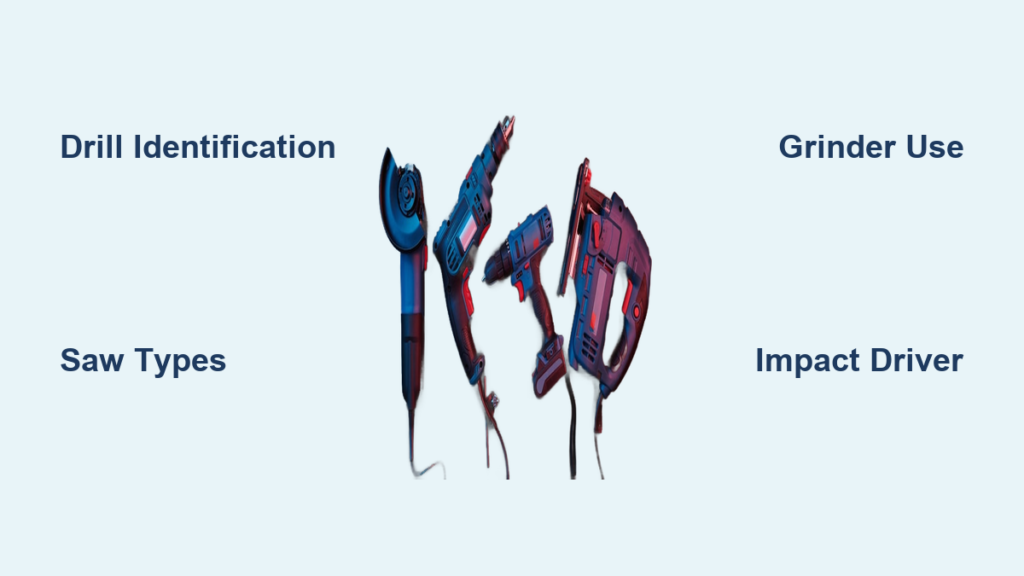
If you’ve ever stood in a workshop or scrolled through a hardware website, staring at a spinning disc, a toothed blade, or a pistol-shaped gadget and asked, “What is that?”—you’re not alone. With hundreds of power tools on the market, each designed for a specific job, knowing power tools names and pictures is essential. Whether you’re a DIY enthusiast, a construction pro, or an educator creating visual content, being able to identify tools by name and appearance improves safety, efficiency, and confidence.
This guide delivers a clear, visual-based breakdown of the most common and specialized power tools—no images needed. We’ll describe each tool in vivid detail so you can recognize it instantly, explain its purpose, and help you understand where and how it’s used. From drills and saws to grinders, impact drivers, and outdoor equipment, this is your go-to reference for mastering power tools names and pictures.
Drills and Drivers: What Each One Does

These are the backbone of any toolkit—used for making holes and driving screws. Their shapes and features reveal exactly what they’re built for.
How to Spot a Cordless Drill
Visual ID: Pistol-shaped body, rotating chuck at the front, battery attached to the base.
Key Features:
– Keyless 3/8″ or 1/2″ chuck (for quick bit changes)
– Variable speed trigger (press harder = faster spin)
– Reversible rotation (switch between tightening and loosening)
– Torque adjustment collar (prevents over-tightening screws)
This is the most versatile power tool. Use it for drilling into wood, metal, or plastic, and for assembling furniture or hanging shelves. Its compact size and battery power make it ideal for home use and tight spaces.
Hammer Drill vs. Regular Drill: Spot the Difference
Hammer Drill Clues: Heavier build, labeled “Hammer” mode, and a chiseling-like forward motion.
Function: Delivers rapid hammering action while spinning—perfect for drilling into concrete, brick, or stone.
Use Case: Mounting a TV on a concrete wall or installing electrical boxes.
Warning: Never use hammer mode on wood or metal—it can damage both the material and the tool.
Rotary Hammer: The Heavy-Duty Alternative
Why It’s Stronger: Uses electro-pneumatic (EP) technology—air pressure drives a piston for more powerful impacts than a standard hammer drill.
Bit Type: SDS-Plus or SDS-Max shanks (slip into the chuck—no tightening needed).
Visual Cues: Bulkier body, side handle for control, depth gauge, and often a chiseling function.
Best For: Breaking up concrete floors, drilling large anchor holes, or demolition work.
Right Angle Drill: For Tight Spots
Design: L-shaped with the motor at a 90° angle to the chuck.
Where It Shines: Confined areas like behind wall studs, under sinks, or inside cabinets.
Pro Tip: Plumbers and electricians love this tool for running pipes or wires in tight corners.
Magnetic Drill (Mag Drill): Precision on Steel
Unique Feature: Electromagnetic base clamps to metal surfaces like steel beams.
Purpose: Drills accurate, large-diameter holes in structural steel.
Applications: Bridge construction, steel framing, industrial maintenance.
Visual: Cylindrical motor mounted on a flat magnetic base, often with a coolant system to prevent overheating.
Cordless Screwdriver: When You Need Control, Not Power
Visual: Slim, pen-like or small pistol grip, often with a fixed Phillips or hex tip.
Torque Level: Low—designed for light-duty tasks.
Best Uses: Installing small screws in electronics, cabinetry, or tight spots.
Avoid: Driving lag bolts or working on structural projects—use a drill or impact driver instead.
Saws: How to Identify Every Type
Saws are mission-critical for cutting materials cleanly. Each has a distinct look and purpose—knowing the differences prevents costly mistakes.
Circular Saw: The Go-To for Straight Cuts
Visual ID: Flat base plate (shoe), exposed spinning blade on one side, top handle with trigger.
Blade Size: 6 to 10 inches (removable for blade changes).
Adjustments: Depth of cut and bevel angle (up to 45°).
Safety Feature: Retractable lower guard covers the blade when idle.
Use Case: Cutting plywood, framing lumber, or decking boards.
Table Saw: The Workshop Workhorse
Design: Circular blade rises through a flat table surface.
Core Parts:
– Rip fence (guides straight cuts)
– Miter gauge (for angled cuts)
– Riving knife (reduces kickback risk)
Types:
– Benchtop: Portable, lightweight
– Contractor: Mid-sized, good for garages
– Cabinet: Heavy-duty, best for professional shops
Best For: Long, straight rip cuts in wood.
Miter Saw: The Angle-Cutting Expert
Function: Makes precise crosscuts and miter angles (like 45° for trim).
Visual: Blade mounted on a pivoting arm over a rotating base.
Types:
– Standard: Cuts left and right angles
– Compound: Adds bevel tilt for complex joints
– Sliding: Extends arm to cut wider boards
Common Use: Installing crown molding, door frames, or picture frames.
Band Saw: Master of Curves
Mechanism: Continuous loop blade stretched over two wheels.
Table: Supports material; blade width determines how tight a curve it can cut.
Blade Widths:
– Narrow (1/8″): Tight curves
– Wide (1/2″): Straight resawing or thick wood
Types: Benchtop, floor-standing, and vertical (scroll saw variant).
Jigsaw: The Freehand Shaper
Motion: Up-and-down reciprocating blade.
Features:
– Orbital action (faster cutting on wood)
– Variable speed control
– Bevel capability (up to 45°)
Blade Types:
– T-shank: Modern, tool-free change
– U-shank: Older, requires screw tightening
Best For: Cutting stenciled designs, sink cutouts in countertops, or drywall shapes.
Reciprocating Saw (Sawzall): The Demolition King
Visual: Rugged body, blade extends from the front, often used with two hands.
Blade Action: Fast back-and-forth motion.
Applications: Demolition, pruning tree limbs, cutting through pipes or nails-in-wood.
Blade Options: Wood, metal, or demolition-grade (for tough jobs).
Electric Chainsaw: For Tree Work
Design: Chain with sharp teeth moves around a guide bar.
Power Source: Corded or battery-powered.
Safety Features: Chain brake, hand guard, oil reservoir for lubrication.
Visual: Rear handle with trigger, front handle for control, long bar.
Best For: Cutting down trees, trimming branches, or splitting firewood.
Tile Saw: The Wet Cutter
Correct Name: Often mislabeled as “TI Saw”—it’s Tile Saw or Wet Saw.
Function: Cuts ceramic, porcelain, or stone tiles with a diamond blade.
Cooling System: Water tray reduces heat and dust.
Visual: Small table with sliding tray, spinning blade underneath, water reservoir.
Hole Saw: For Large Round Cuts
Design: Cup-shaped with teeth on the edge, requires a pilot bit.
Sizes: 1″ to 6″ in diameter.
Uses: Cutting holes for plumbing pipes, electrical boxes, or door hardware.
Materials: Wood, drywall, thin metal.
Grinders and Polishing Tools: Shaping Hard Surfaces
These tools smooth, shape, and finish tough materials like metal, concrete, and stone.
Angle Grinder: The Multi-Tasker
Visual ID: Disc mounted at a right angle to the motor, side handle, adjustable guard.
Disc Sizes: 4.5″, 5″, 7″, 9″.
RPM: 5,000–12,000.
Attachments:
– Cut-off wheels
– Grinding stones
– Wire brushes
– Sanding pads
Uses: Cutting rebar, grinding welds, removing rust, or polishing metal.
Bench Grinder: The Stationary Sharpener
Design: Two grinding wheels (coarse and fine) on one shaft, mounted to a workbench.
Features: Tool rests and wheel guards for safety.
Function: Sharpening chisels, drill bits, and lawnmower blades.
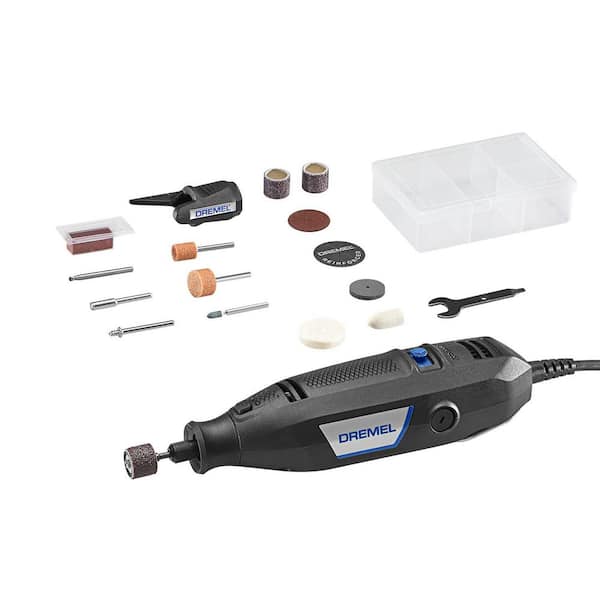
Rotary Tool (Dremel): The Detail Artist
Visual: Pen-shaped, high-speed motor, small collet for bits.
Speed: Up to 35,000 RPM.
Attachments:
– Engraving bits
– Sanding drums
– Cutting wheels
– Polishing pads
Best For: Jewelry making, model building, deburring metal, or engraving.
Impact and Fastening Tools: Power for Driving

These deliver high force to drive screws, nails, and bolts quickly and securely.
Impact Driver: High-Torque Screw Tool
Visual: Shorter than a drill, hex bit holder, retention ring.
Power: Rotational + hammering action—no cam-out.
Use: Decking, framing, automotive work.
Warning: Not for drilling—only for driving fasteners.
Impact Wrench: Nut-Loosening Power
Function: Tightens or loosens nuts and bolts with extreme torque.
Drive Sizes: 1/4″, 3/8″, 1/2″, up to 3½”.
Power Types: Pneumatic (most common), cordless, hydraulic.
Where Used: Auto repair shops, construction, heavy machinery.
Nail Gun: Fast, Consistent Fastening
Visual: Pistol-shaped with a nail magazine and nose piece.
Types:
– Framing Nailer: 3″ nails, for wood framing
– Finish Nailer: Trim and molding
– Brad Nailer: 18-gauge, light trim work
– Roofing Nailer: Fastens shingles
Power Source: Air compressor or battery.
Sanders and Surface Tools: For Smooth Finishes
Essential for prepping surfaces before painting or sealing.
Orbital Sander: Swirl-Free Sanding
Motion: Random small orbits prevent visible sanding marks.
Pad Shape: Round or square.
Dust Control: Vacuum port for shop vac connection.
Use: Final sanding on furniture or cabinets.
Belt Sander: Aggressive Material Removal
Design: Continuous sanding belt over two drums.
Use: Floor sanding, leveling wood, or shaping curves.
Form: Handheld or floor model.
Planer: Flattens Lumber in Seconds
Function: Removes material to achieve uniform thickness.
Types:
– Handheld: For edge jointing or tapering
– Benchtop: For full board thicknessing
Visual: Flat base with spinning cutter head, infeed/outfeed tables.
Specialty Power Tools: For Unique Jobs
These handle tasks that standard tools can’t.
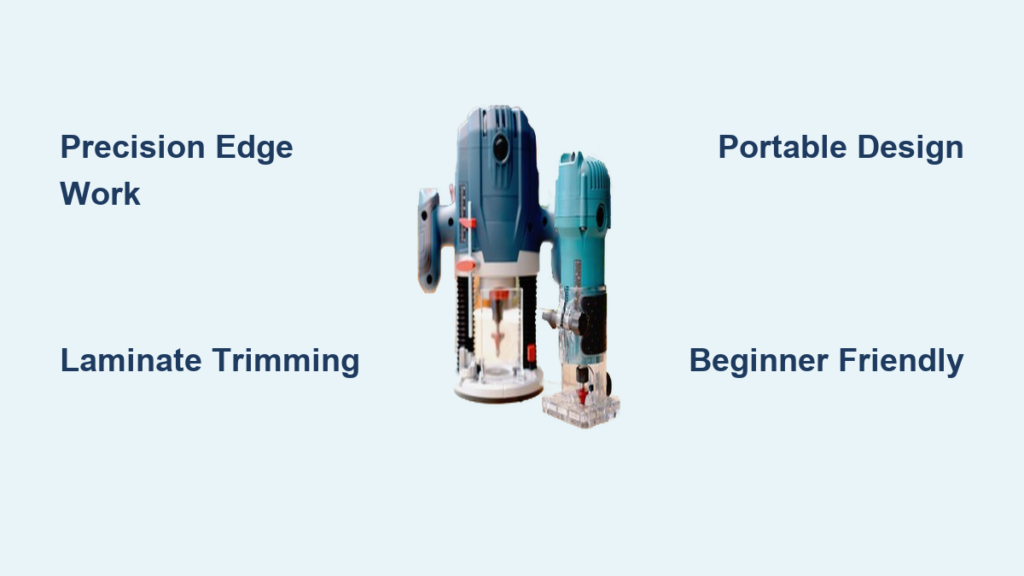
Router: Wood Shaping Pro
Function: Hollows out wood for grooves, edges, and joints.
Types:
– Plunge Router: Starts cut in the middle
– Fixed-Base: Consistent depth
– Trim Router: Small, for edge work
Bit Types: Round-over, chamfer, dovetail, flush-trim.
Visual: Motor under base, bit extends down, top handles.
Jackhammer: Concrete Breaker
Power Source: Pneumatic, electric, or hydraulic.
Action: Rapid chisel strikes via internal hammer.
Use: Breaking pavement, foundations, or rock.
Safety: Use with a PAM (Positioner–Actuator–Manipulator) to reduce vibration.
Concrete Vibrator: Strengthens Wet Concrete
Function: Removes air bubbles from poured concrete.
Design: Flexible shaft with vibrating tip.
Where Used: Columns, slabs, footings.
Result: Denser, stronger cured concrete.
Heat Gun: Hot Air for Many Tasks
Temperature: 100–760°C (200–1400°F).
Uses:
– Strip paint
– Shrink tubing
– Bend PVC
– Soften adhesives
– De-solder electronics
Visual: Pistol shape, heating element, nozzle attachments.
Warning: Avoid >590°C when removing lead-based paint.
Generator: Off-Grid Power Source
Function: Powers corded tools where electricity isn’t available.
Fuel Types: Gasoline, diesel, propane.
Visual: Box with engine, outlets, control panel.
Use: Job sites, emergencies, outdoor projects.
Final Tips for Using Power Tools
- Match Tool to Task: Use a circular saw for straight cuts—not a jigsaw.
- Check Power Source: Cordless = mobility, corded = constant power.
- Inspect Before Use: Look for frayed cords, cracked housings, dull blades.
- Follow Manual Instructions: Each tool has safety rules.
- Start with Essentials: Drill, circular saw, sander—add specialty tools as needed.
Knowing power tools names and pictures isn’t just about labeling—it’s about working safely and efficiently. With this guide, you’ll never wonder “What is that tool?” again.