
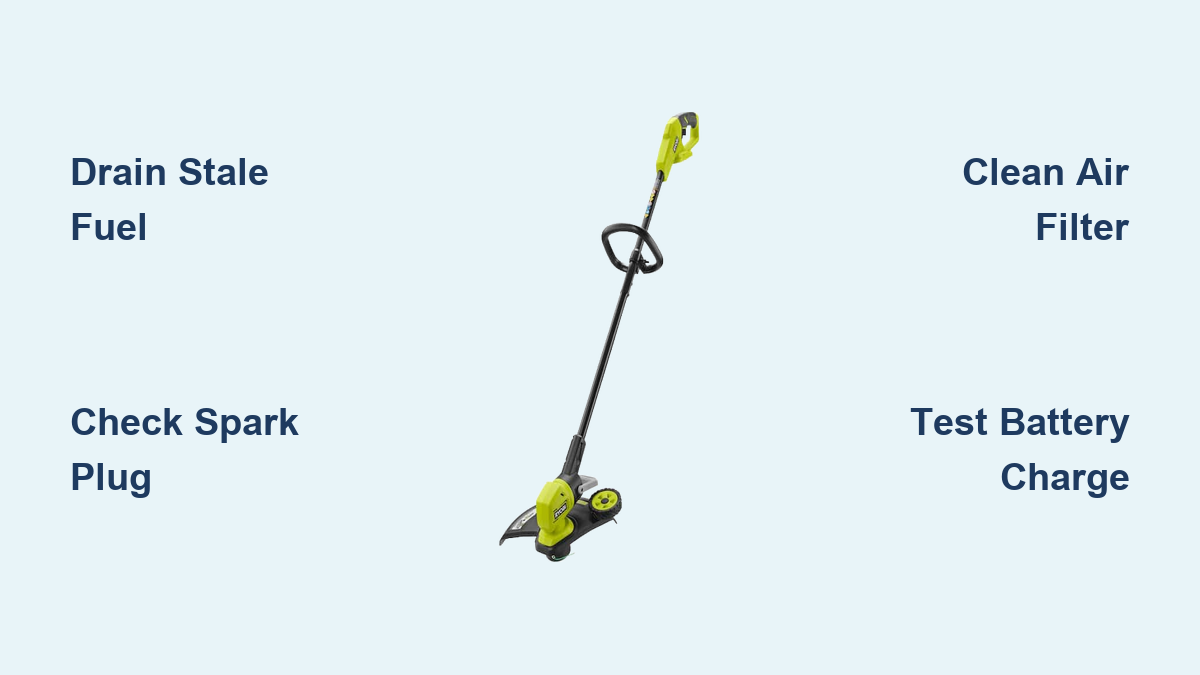
You’re standing in your overgrown yard, ready to tackle the weeds, but when you pull the starter cord on your Ryobi weed trimmer, nothing happens. No sputter, no cough—just silence. This frustrating scenario affects thousands of homeowners each season, yet most starting problems can be fixed in under 30 minutes with basic tools and systematic troubleshooting. Whether you own a gas-powered RY40200 or a battery-operated RY40230, this guide will help you diagnose and resolve the issue so you can get back to yard work without unnecessary expense or delay.
Starting failures typically stem from just four critical systems: fuel delivery, ignition, air supply, or mechanical function. By methodically checking each component in the proper sequence, you’ll identify your specific problem faster than guessing or replacing parts randomly. Most Ryobi trimmer owners discover their starting issue relates to simple maintenance oversights rather than catastrophic failure, saving them hundreds in unnecessary repairs or replacements.
Diagnose Fuel-Related Starting Failures Immediately

Stale fuel causes more Ryobi trimmer starting problems than any other single issue. Two-stroke engines require precise fuel-to-oil ratios (typically 50:1), and gasoline degrades significantly within 30 days. If your trimmer sat unused for weeks or months, old fuel has likely formed varnish deposits that clog your carburetor and fuel lines.
Drain all old fuel from your tank into an approved container—don’t just top it off with fresh mixture. Locate the fuel drain screw (usually at the carburetor base) or disconnect the fuel line to completely empty the system. Inspect the drained fuel: dark color, cloudiness, or separation indicates contamination requiring thorough system cleaning. Refill with fresh 50:1 pre-mix using ethanol-free gasoline when possible, as ethanol attracts moisture and accelerates degradation.
Check Fuel Filter and Line Integrity
Your Ryobi trimmer won’t start if the fuel delivery system can’t supply adequate mixture to the carburetor. Remove the fuel cap and inspect the in-tank filter (a small mesh screen at the end of the fuel line). A clogged filter restricts fuel flow, especially when the trimmer is tilted during operation. Replace any filter showing discoloration or debris accumulation—most cost under $5.
Examine the entire fuel line for cracks, stiffness, or deterioration. Perished rubber lines suck air instead of fuel, creating lean running conditions that prevent starting. The line should feel supple, not brittle. Replace both supply and return lines simultaneously using Ryobi-specified 3/32″ ID fuel line to ensure proper fit and chemical resistance to ethanol blends.
Verify Proper Choke Operation
Many users overlook the choke mechanism when their Ryobi weed trimmer won’t start. The automatic choke on models like the RY40200 must function correctly for cold starts. With the fuel cap off, move the choke lever through its range while observing fuel flow into the carburetor. You should see a noticeable increase in fuel delivery when engaging the choke.
If no additional fuel flows when activating the choke, the diaphragm or linkage has failed. For manual choke models, ensure the butterfly valve inside the carburetor throat opens and closes fully with choke movement. A sticky choke valve prevents the rich mixture needed for cold starting, leaving you pulling the cord endlessly with no result.
Fix Spark Plug and Ignition System Failures
A strong blue spark is non-negotiable for engine ignition. When your Ryobi trimmer won’t start, testing the spark plug should be your second diagnostic step after confirming fuel delivery.
Test and Replace Faulty Spark Plugs
Remove the spark plug using a 5/8″ socket and inspect the electrode gap (should measure 0.020-0.025″). Carbon buildup, oil fouling, or excessive electrode wear prevents proper spark generation. Clean fouled plugs with a wire brush, but replace plugs showing white deposits (indicating overheating) or significant electrode erosion.
To test spark properly, reconnect the plug wire, ground the plug against the cylinder head, and pull the starter cord with brisk, full strokes. A healthy spark appears bright blue and snaps sharply. Yellow, orange, or intermittent sparks indicate ignition coil problems. Always replace spark plugs annually as preventative maintenance—most fail gradually before complete failure.
Diagnose Ignition Coil and Kill Switch Issues
If your spark plug tests good but the engine still won’t start, check the kill switch circuit. Many Ryobi models (like the RY40230) have safety switches that ground the ignition when activated. Disconnect the kill switch wire from the ignition coil and attempt starting—bypassing this circuit isolates switch-related failures.
Use a multimeter to test coil resistance: measure between the spark plug wire terminal and engine ground. Most Ryobi coils read 2.5-5.0 kΩ primary resistance and 5,000-15,000 Ω secondary resistance. Readings outside these ranges indicate a failing coil requiring replacement. Before buying a new coil, inspect the magneto flywheel key—shearing this small key misaligns timing and prevents starting despite good spark.
Clear Airflow Restrictions Preventing Combustion

Your Ryobi weed trimmer needs precise air-to-fuel ratios for combustion. Restricted airflow creates overly rich mixtures that flood the engine and prevent starting.
Clean or Replace Clogged Air Filters
Remove the air filter cover (secured by one or two screws on most Ryobi models) and inspect the filter element. Foam filters common on gas trimmers become saturated with oil and debris, blocking critical airflow. Wash foam filters in warm, soapy water, squeeze dry with a clean towel, and re-oil lightly with air filter oil before reinstalling.
Paper filters on some models require complete replacement when dirty—they cannot be cleaned effectively. Never operate your trimmer without a filter, as even minute debris causes rapid cylinder scoring. A clean filter should appear light tan, not dark brown or black. Replace filters every 25 operating hours or monthly during peak season.
Adjust Carburetor Mixture Screws Correctly
When your Ryobi weed trimmer won’t start despite good fuel, spark, and airflow, improper carburetor adjustment is likely. Locate the idle speed and mixture screws (usually labeled “L” for low speed and “H” for high speed). Turn both screws clockwise until lightly seated, then back out 1.5 turns as a baseline setting.
Start with the low-speed mixture screw: turn counterclockwise in 1/8-turn increments until the engine idles smoothly. If the engine bogs or dies, the mixture is too lean—turn clockwise slightly. Proper adjustment creates stable idle without throttle input. Incorrect settings cause flooding during starting attempts, especially on cold engines.
Troubleshoot Battery and Electrical Failures on Cordless Models
Battery-powered Ryobi trimmers (like the RY40230) fail to start primarily due to electrical system issues. Unlike gas models, the problem is usually isolated to three components.
Test and Replace Failing Batteries
Remove the battery pack and check charge level on your Ryobi charger. If the charger shows “fault” or the battery won’t accept charge after 30 minutes, internal cell failure has occurred. Test voltage with a multimeter: a fully charged 40V Ryobi battery should read 42-44V. Below 36V indicates end-of-life failure requiring replacement.
Check for physical damage—swollen battery packs must be retired immediately. Clean corrosion from battery contacts using a pencil eraser or contact cleaner. Ensure the battery clicks securely into place; loose connections prevent power delivery even with a charged battery.
Inspect Power Switch and Wiring
The power switch on cordless Ryobi trimmers develops internal corrosion from moisture exposure. Remove the switch housing and inspect contacts for pitting or oxidation. Test switch continuity with a multimeter—activating the switch should show near-zero resistance. Replace faulty switches rather than attempting repair.
Examine all wiring connections between battery terminals, switch, and motor. Loose or corroded connections create high resistance that prevents adequate power delivery. Secure any loose terminals and apply dielectric grease to prevent future corrosion. Damaged wiring harnesses require complete replacement for safety.
Verify Proper Starter Mechanism Function
Gas-powered Ryobi trimmers require the starter assembly to spin the engine fast enough to generate compression and spark.
Inspect Recoil Starter Assembly
Remove the starter housing screws and examine the recoil mechanism. The pull cord should retract smoothly without binding. Frayed cords indicate impending failure—replace before complete breakage. Check the rewind spring tension: weak springs prevent sufficient engine rotation speed for starting.
Verify pawl engagement—small metal arms that catch the flywheel must extend fully when pulling the cord. Stiff or broken pawls prevent engine rotation. Clean pawl mechanisms with carburetor cleaner and apply light lubricant to pivot points. Replace broken pawls to restore proper starter function.
Check Automatic Decompression Valve
Many Ryobi gas trimmers feature an automatic decompression valve that reduces starting effort. If stuck closed, excessive compression prevents pulling the starter cord fully, creating insufficient rotation speed. With the spark plug removed, pull the cord—you should feel significantly less resistance. If compression remains high, the decompression valve needs cleaning or replacement.
Implement Preventative Maintenance to Avoid Future Failures
Prevent your Ryobi weed trimmer from refusing to start by establishing these simple maintenance habits:
- Drain fuel after each use during the season or add STA-BIL 360 Marine fuel stabilizer
- Replace spark plugs at the start of each season regardless of condition
- Clean air filters after every 5 hours of operation
- Store trimmers vertically with empty fuel tanks during off-seasons
- Run battery-powered models until nearly depleted before long-term storage
Your Ryobi weed trimmer won’t start because one critical system isn’t delivering what the engine needs for combustion. By methodically checking fuel delivery, spark generation, airflow, and mechanical function in that sequence, you’ll identify and resolve the issue efficiently. Most starting problems stem from simple maintenance oversights rather than catastrophic failure—fresh fuel, a clean spark plug, and proper carburetor adjustment solve 80% of no-start scenarios. When faced with persistent starting issues beyond these basic checks, consult an authorized Ryobi service center for professional diagnosis before investing in unnecessary parts. Consistent maintenance prevents these frustrating failures and extends your trimmer’s service life for many seasons of reliable performance.
Leave a Reply