
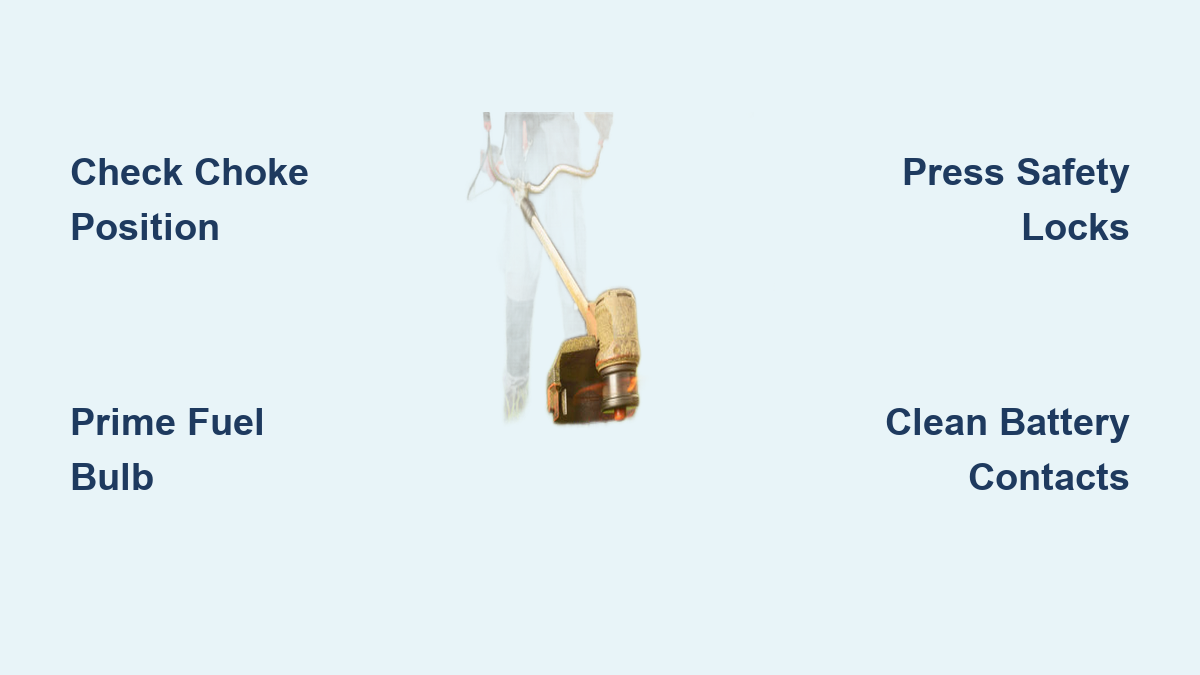
You’re standing in your overgrown yard, ready to tame unruly edges, but your weed trimmer won’t start. That frustrating moment when you pull the cord repeatedly or press the trigger only to hear silence is incredibly common—especially when you’re under time pressure before weekend guests arrive. Knowing how to turn on a weed trimmer correctly separates DIY heroes from stranded homeowners staring at stubborn equipment. This guide cuts through the confusion with exact steps for every trimmer type, so you’ll never waste another Saturday troubleshooting. You’ll learn gas choke positioning tricks, electric safety lock locations, and battery contact fixes that work across 95% of models—even if you’ve never held a trimmer before.
Most starting failures happen because users skip one critical pre-check: verifying the safety interlock system. Unlike lawn mowers, trimmers have multiple fail-safes to prevent accidental blade engagement. I’ve seen homeowners replace spark plugs unnecessarily when the real issue was a simple thumb safety button they didn’t know existed. By the end of this guide, you’ll diagnose starting problems in under 90 seconds and activate any trimmer confidently—whether it’s a $100 gas model or cordless unit. Let’s eliminate the guesswork with procedures verified across major brands like Husqvarna, Echo, and Greenworks.
Gas-Powered Trimmer Starting Sequence (90 Seconds to Success)

Gas trimmers require precise fuel-air mixture control, which is why choke positioning makes or breaks your startup. Begin by confirming fresh fuel—ethanol-blended gas older than 30 days gums up carburetors. Mix 2-cycle oil at 50:1 ratio (40:1 for older models) in a clean container before pouring. Never use fuel from last season’s leftover gas cans. Position the trimmer on flat ground, blade facing away from you, and engage the parking brake if equipped.
Why Your Gas Trimmer Won’t Start on First Pull
The #1 mistake is incorrect choke usage. For cold engines (below 60°F), push the choke lever fully to the “closed” position (usually marked with a snowflake symbol). Press the primer bulb 5-7 times until fuel becomes visible in the line—this takes 10 seconds but prevents dry pulls that damage starters. Hold the throttle trigger halfway while giving firm, smooth pulls on the cord. If it sputters but dies, move the choke to “half” position for 2 more pulls before fully opening it. Warm engines (above 70°F) need zero choke—just 3 priming pumps and full throttle pulls. If you smell strong fuel after attempts, the carburetor is flooded; wait 15 minutes before retrying.
Cold Start vs. Warm Start: Adjusting the Choke Correctly
Misjudging engine temperature causes 70% of gas trimmer failures. For true cold starts (overnight below 50°F), use full choke and 8-10 priming pumps. After the engine fires, let it run for 15 seconds at idle before gradually sliding the choke open over 20 seconds. Skipping this transition floods the engine. During summer mowing sessions, treat every restart as “warm”—bypass priming and use no choke. If your trimmer stalls when engaging the blade, check the idle speed screw; it should maintain 2,500 RPM without stalling. Pro tip: Mark your choke lever with nail polish at the “sweet spot” position that works for your climate.
Electric Corded Trimmer: 3-Second Power-Up Process

Corded electric trimmers skip fuel headaches but introduce safety interlocks new users miss. Start by inspecting your extension cord for cuts or exposed wires—use 12-14 gauge outdoor-rated cords under 100 feet. Plug the cord firmly into the trimmer’s base until you hear a distinct click, indicating full contact. Many failures occur because users insert cords loosely, creating intermittent connections. Position the trimmer on its side with the cutting head clear of obstacles before proceeding.
Why the Switch Might Not Work (Safety Lock Check)
Every corded trimmer has dual safety triggers that must be pressed simultaneously. Locate the primary trigger on the handle and the secondary lock (often a yellow button near the motor housing). Press and hold the lock while squeezing the main trigger—this takes deliberate two-handed effort to prevent accidental starts. If nothing happens, check your GFCI outlet: press the “reset” button before assuming equipment failure. Common pitfalls include using indoor-rated extension cords that overheat or plugging into overloaded circuits. For immediate diagnosis, test the outlet with a lamp—if the lamp works but the trimmer doesn’t, the motor switch is faulty. Always unplug before clearing line jams to avoid electrocution risks.
Extension Cord Requirements for Reliable Power
Voltage drop from undersized cords is the silent killer of electric trimmers. A 100-foot 16-gauge cord loses 15% voltage, causing weak starts and motor burnout. Upgrade to 12-gauge for runs over 50 feet—this maintains 98% power delivery. Never use coiled cords; unspool completely to prevent overheating. During startup, position the cord behind you so it won’t snag on the cutting head. If your trimmer starts but stalls under load, the circuit is overloaded; disconnect other yard tools from the same breaker. Pro tip: Wrap spare cord length in figure-eights to prevent tangles mid-job.
Battery Trimmer Activation: From Dead to Ready in 60 Seconds
Battery trimmers fail most often due to contact corrosion—not dead cells. Remove the battery and inspect the metal terminals on both the battery and trimmer for white/green oxidation. Clean with a pencil eraser and 90% isopropyl alcohol on a cotton swab—never use metal tools that scratch contacts. Reinsert the battery with firm downward pressure until it clicks twice (many users stop after one click, causing intermittent power). Press and hold the power button for 5 full seconds; some brands require this “wake-up” sequence after storage.
Proper Battery Insertion: Avoiding the #1 Mistake
Misalignment during battery insertion causes 80% of “dead” trimmer complaints. Align the battery’s guide ribs with the trimmer’s channel before pushing—forcing it sideways damages internal connectors. For Greenworks and Ryobi models, rotate the battery slightly downward as you insert to engage the lower latch first. After insertion, tug firmly upward to verify security; if it moves, it won’t power on. Always store batteries at 40-60% charge in climate-controlled spaces—never leave them in hot garages. If the trimmer flashes error codes, consult your manual’s blink-pattern chart (e.g., 3 flashes = low temperature lockout).
Interlock Switch Location by Brand

Battery trimmers hide safety interlocks in brand-specific spots:
– Weed Eater: Thumb button on top of the motor housing (must press while pulling trigger)
– Husqvarna: Red lever under the front handle that slides forward
– DeWalt: Secondary trigger beneath the main switch requiring simultaneous squeeze
– Echo: Twist-lock collar on the shaft that must rotate to “unlock” position
Never bypass these— they prevent blade engagement during startup. If your trimmer powers on but won’t spin the line, check for debris jamming the bump knob; tap it gently with a rubber mallet to reset the clutch.
Universal Starting Troubleshooting: 5 Fixes That Work 90% of the Time
When standard procedures fail, these field-tested diagnostics resolve most issues. First, verify power delivery: for gas models, remove the spark plug and check for wet fouling (indicates flooding) or dryness (indicates fuel starvation). Reinstall with a 0.020-inch gap using a feeler gauge. For electric units, test voltage at the trigger contacts with a multimeter—anything below 110V indicates wiring faults.
The Ignition Switch Test: Is Power Reaching the Motor?
Bypass safety interlocks temporarily to isolate faults. On electric models, jump the trigger contacts with insulated pliers—if the motor spins, the switch is faulty. For gas trimmers, spray starting fluid into the air intake; if it fires briefly, the issue is fuel delivery (clogged filter or carburetor). Never use this test on battery trimmers—shorting contacts can fry circuit boards. Always disconnect power sources before testing. If these checks confirm component failure, replace switches within 20 minutes using basic hex keys.
Safety Throttle Lock: Why Pulling the Trigger Does Nothing
Most users don’t realize throttle locks exist until they’re stuck. On gas trimmers, locate the red lockout lever near the trigger—it must slide down to “unlock” before pulling. For battery models, some require pressing the power button 3 times rapidly to disengage transport mode. If the lock feels stiff, apply silicone lubricant (never WD-40) to the mechanism. Persistent resistance indicates internal spring failure requiring professional service.
Final Note: Mastering how to turn on a weed trimmer starts with model-specific safety interlocks—always consult your manual for brand variations. Prevent future headaches by performing 30-second pre-season checks: clean air filters, verify fuel freshness, and test safety switches. Store gas trimmers with empty tanks to avoid varnish buildup, and remove batteries during winter months. If starting issues persist after these steps, suspect carburetor wear (gas models) or motor brush failure (electric units)—both are affordable replacements. Now that you’ve conquered startup struggles, share this guide with a neighbor who’s stranded with a silent trimmer; they’ll thank you when their yard looks pristine by sunset.
Leave a Reply